
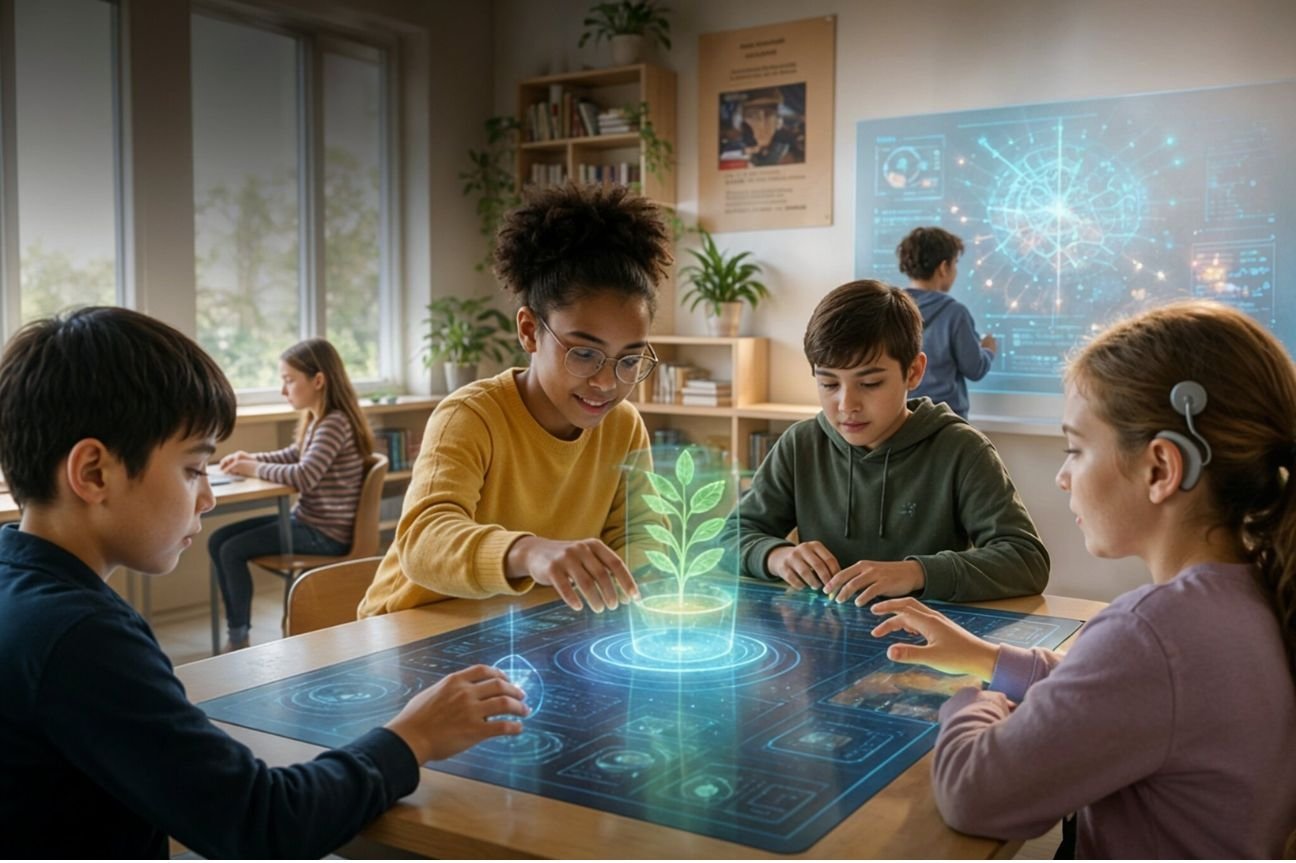
The Wrong Assumption at the Center of Education
There is a foundational design flaw at the center of most education systems in the world. It is not a funding flaw, a curriculum flaw, or a technology flaw, though all of those exist. It is something far more fundamental: the assumption that all children learn in roughly the same way, through the same methods, measured by the same tests.
That assumption has never been accurate. We now have the science, the developmental psychology, and the lived evidence of millions of children to prove exactly how costly it is and to point clearly toward something better.
The future of education is not more standardized. It is sensory-aware. It is built around how individual brains actually develop and process information, not around the institutional convenience of delivering content in a single format. And this is not simply an equity argument, though it is profoundly that. It is a psychological and educational effectiveness argument that affects every learner in every classroom.
The Scale of What Standardization Is Costing
The numbers alone make a compelling case for change.
According to UNESCO's Global Education Monitoring Report, 272 million children and youth were out of school globally, an increase of over 21 million from the previous estimate, with countries now projected to fall off-track by 75 million relative to their national targets by 2025.
A joint report by the World Bank, UNESCO, and UNICEF found that 70% of 10-year-olds in low- and middle-income countries cannot understand a simple written text, with this generation at risk of losing $21 trillion in potential lifetime earnings.
These are not simply access failures. They are designed failure systems built around a narrow definition of how learning happens that excludes the psychological reality of how children actually grow and develop.
How Children's Brains Actually Work
Child psychology and neuroscience have built a consistent and increasingly detailed picture of how learning actually happens in the developing brain, and it looks nothing like a lecture delivered to rows of silent children.
The developing brain learns through experience, through movement, through emotion, and through sensory engagement with the world. From infancy onward, children construct understanding by doing, touching, exploring, and connecting new information to lived experience. This is not a learning style preference. It is how the brain is neurologically wired to build knowledge during childhood and adolescence.
When a child is asked to sit still, suppress physical impulses, filter out environmental noise, and process information through a single auditory channel for sustained periods, they are being asked to operate against the grain of their own developmental psychology. For some children, the effort required to manage that mismatch leaves little cognitive capacity for the actual learning they are supposed to be doing.
Research in Frontiers in Human Neuroscience confirms that the conventional school model built on memorizing content detached from body, context, and sensory experience has systematically constrained the role of multimodal learning in educational design, depriving learners whose psychological and cognitive profiles do not fit the assumed norm.
This creates a growing and costly gap between what education systems measure and what actually determines how children learn, grow, and thrive.
The Neurodiversity Reality Systems Are Not Built For
The OECD has identified neurodiversity, including ASD and ADHD, as affecting increasingly large numbers of students globally, representing a dimension of human psychological variation that conventional educational frameworks were never designed to accommodate.
The consequences of that design gap are measurable and significant. Teacher-reported school attendance problems appear in 42.6% of autistic students, compared to just 7.1% of neurotypical students, with neurodivergent students absent on significantly more days, suggesting that for many of these children, the school environment itself has become the primary barrier to participation.
The critical insight here is psychological, not logistical. These are not students who cannot learn. They are students whose psychological and sensory profiles have never been adequately understood or designed for by the systems meant to serve them. Locating the problem in the child rather than in the system is not only inaccurate. It is harmful, and it compounds the very disadvantage education is supposed to address.
What Sensory-Aware, Psychologically Informed Education Looks Like
Sensory-aware education is not a niche intervention for a minority of students. It is a design philosophy grounded in child psychology, one that begins with the understanding that learner variability is the norm, and that learning environments should be built around how children actually develop rather than how institutions prefer to deliver content.
When children feel psychologically safe, when they are not spending cognitive and emotional energy managing anxiety, suppressing sensory responses, or masking the ways their brains differ from the expected norm, they can direct that energy toward learning. That is not a peripheral consideration. It is the prerequisite for everything else.
One of the most established frameworks supporting this approach is Universal Design for Learning. Large-scale research published in Scientific Reports, examining 2,473 learners across 87 educational facilities, found that full UDL implementation produced a 37.4% increase in overall learner performance and a 42.8% improvement among previously disengaged learners.
These gains are not driven by technology or facility upgrades. They are driven by a fundamental shift in how teaching is designed from a single-channel, one-pace model to one that acknowledges the psychological diversity of the children in the room and responds to it with flexibility, choice, and genuine inclusion.
The Equity and Policy Case
OECD data show that children from low-income families are significantly less likely to access quality early childhood education, with disadvantage compounding sharply when it intersects with learning differences, sensory processing variation, or neurodevelopmental profiles.
The shift toward sensory-aware, psychologically informed education is not simply an improvement in teaching practice. It is a structural equity intervention that offers the greatest benefit to the children most consistently failed by standardized approaches. These are often the same children already navigating social and economic disadvantage. Designing education that works for their psychological reality is not an accommodation. It is an overdue correction.
At the policy level, momentum is growing. Frameworks like Universal Design for Learning are increasingly reflected in national education strategies, signaling a broader shift toward adaptive, learner-centered models. The evidence is clear. The frameworks exist. What remains is the institutional will to act on what child psychology has been telling us for decades.
One Design That Works for Everyone
The argument here is not that standardized assessments should be abandoned or that rigor has no place in education. It is that rigor built on a misunderstanding of child psychology produces fragile outcomes, and that education designed around how children's brains actually develop produces stronger ones.
The future of education is not one size fits all. It is one design that is flexible, psychologically grounded, and genuinely responsive that works for every child it is meant to serve.