
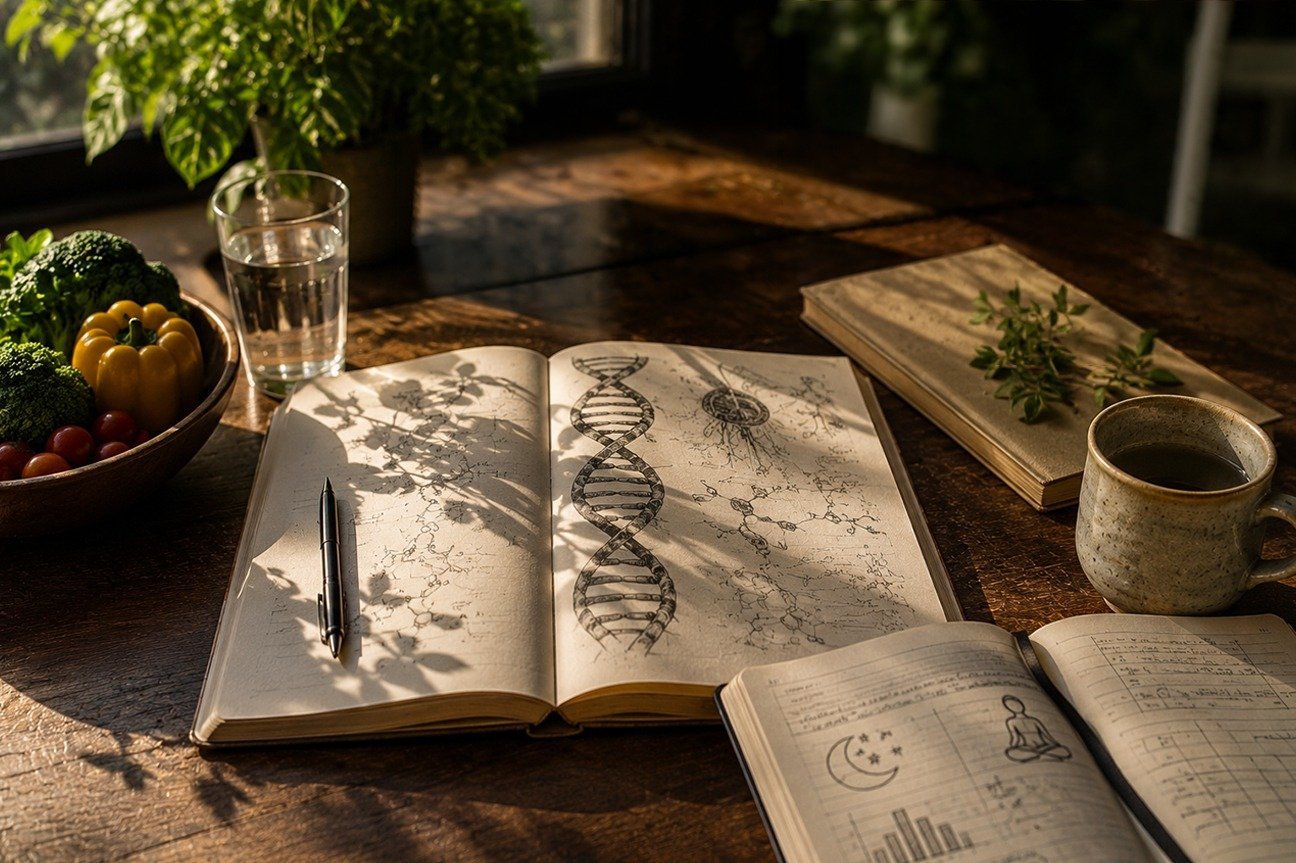
Genes may provide the blueprint, but our lives influence how that blueprint is read.
Before there were blood tests, MRIs, genetic sequencing, wearable health technology, and sophisticated laboratories, humanity still faced a fundamental question:
How do we know when someone is healthy?
For thousands of years, cultures around the world developed remarkably sophisticated ways of answering that question. They observed the body. They paid attention to energy, digestion, sleep, mood, fertility, appetite, resilience, breath, skin, eyes, and movement. They watched how people responded to food, seasons, stress, grief, work, and community.
The body itself became the first laboratory.
Long before modern medicine could measure disease, people learned to observe health.
Today, we have unprecedented access to medical technology. We can monitor our heart rate from a watch, analyze our DNA, measure hormones, track blood sugar, and identify disease earlier than ever before. These advances have transformed healthcare and improved countless lives.
Yet despite all of our scientific progress, chronic disease continues to rise across the globe.
We know more about the human body than ever before, yet many people have never been taught how to understand the signals their bodies are sending them.
We have become experts at measuring illness while becoming less skilled at recognizing the conditions that create it.
As a nutritional therapist, I often approach health from a different perspective. While symptoms matter, they are rarely where the story begins.
Instead, I ask a different question:
What Is Happening in This Person’s Life That Is Influencing How Their Genes Are Being Expressed?
Today, science gives us a word for this relationship: epigenetics.
Epigenetics is the study of how nutrition, stress, sleep, movement, environmental exposures, relationships, and lived experiences influence gene expression. While our genes provide the blueprint, our daily lives influence how that blueprint is read.
In many ways, modern science is confirming what traditional cultures observed centuries ago.
The body responds to its environment.
For generations, healers, elders, midwives, herbalists, and traditional practitioners understood that health could not be separated from daily life. They recognized that food, community, stress, purpose, movement, rest, and environment all played a role in shaping wellbeing.
Different cultures developed different languages for understanding health, yet many arrived at remarkably similar conclusions.
In Ayurvedic traditions, digestion is considered central to health. Foods are selected not only for their nutritional value but for their effect on the body’s balance. Foods rich in water and fiber are often used to support elimination, digestion, and overall wellbeing. Herbs are not viewed simply as flavorings but as tools that influence physiological function.
Throughout the Caribbean, generations learned to identify plants not only by name but by purpose. Families understood which plants supported digestion, recovery, circulation, and seasonal cleansing. Bitter herbs were commonly used to stimulate digestion and support overall health long before researchers began exploring the relationship between gut health, inflammation, and chronic disease.
Across Africa and throughout the African diaspora, communities often relied on seasonal eating patterns built around locally available foods. Beans, peas, sprouts, greens, roots, and grains provided nourishment throughout the year. Food was not merely consumed; it was understood. Communities recognized that different seasons required different approaches to nourishment and recovery.
Although these traditions emerged in different parts of the world, they shared a common understanding:
- The body leaves clues.
- Long before laboratories existed, people learned to read them.
- Changes in energy were noticed.
- Changes in sleep were noticed.
- Changes in digestion were noticed.
- Changes in skin, hair, appetite, fertility, and mood were noticed.
- The body often whispers long before it screams.
Today, many people dismiss these signals because they have not yet developed into a diagnosis. Yet traditional cultures understood that health and disease often exist on a continuum. The body rarely moves from wellness to illness overnight.
Instead, patterns emerge.
The person who feels exhausted despite adequate rest.
The individual whose digestion gradually worsens over time.
The person living under chronic stress begins to experience inflammation, weight changes, or hormonal imbalance.
The worker survives on poor sleep and highly processed foods.
The parent is carrying emotional burdens while neglecting their own health.
These experiences are often viewed as normal parts of modern life.
Yet they are also biological experiences.
Every source of stress creates a physiological response.
Every meal provides information to the body.
Every night of sleep influences recovery and repair.
Every environment shapes the way the body adapts.
Eventually, those adaptations become visible.
Not only through laboratory values but through symptoms, behaviors, resilience, and overall wellbeing.
This is where traditional observation and modern science intersect.
Long before ferritin tests existed, people recognized the signs of blood deficiency: fatigue, weakness, dizziness, poor recovery, and pallor.
Long before the discovery of the microbiome, cultures around the world incorporated fermented foods into their diets.
Long before scientists understood cortisol and chronic stress, communities recognized that grief, hardship, exhaustion, and emotional burden affected physical health.
The remarkable thing about modern medicine is not that it disproved these observations.
In many cases, it helped explain them.
This does not mean traditional wisdom should replace modern medicine.
Nor does it mean that modern medicine should dismiss generations of observational knowledge.
The future of healthcare is not choosing one over the other.
It is learning how to integrate both.
We need science.
We need physicians.
We need research.
We need diagnostics.
We need evidence-based medicine.
But we also need people who understand their own bodies.
People who can recognize patterns before they become pathology.
People who understand the relationship between lifestyle and health.
People who know how to ask better questions.
Why am I always tired?
Why is my digestion changing?
Why am I waking up every night?
How is stress affecting my body?
How is my environment influencing my health?
What role is nutrition playing?
What is my body trying to tell me?
These questions do not replace medical evaluation.
They complement it.
They transform people from passive recipients of healthcare into active participants in their own wellbeing.
Perhaps this is the greatest lesson traditional cultures have to offer us.
Health is not simply the absence of disease.
Health is a dynamic relationship between our biology and our environment.
Our lives become a reflection of how our genes are expressing themselves.
The food we eat.
The stress we carry.
The relationships we maintain.
The communities we belong to.
The environments we inhabit.
The habits we repeat every day.
All of these influence the story our bodies tell.
We have spent centuries building laboratories to understand the human body, and those discoveries have transformed medicine. Yet in our pursuit of measurement, we may have forgotten the value of observation. Before we could test blood, we learned to recognize vitality. Before we could measure hormones, we observed the effects of stress. Before we understood epigenetics, we recognized that food, environment, community, and lived experience shaped health. The future of healthcare is not choosing between traditional wisdom and modern science. It is recognizing that both seek to answer the same question: What does it mean to be well? The first laboratory was the human body, and it is still speaking. Every symptom, every strength, every adaptation tells a story. The question is whether we have remembered how to listen.