
We are living through the most consequential technological transition of the modern era. Artificial intelligence is no longer confined to research laboratories or experimental pilots. It is transforming industries, redefining workforces, and reshaping how institutions operate at a pace few earlier technologies achieved.
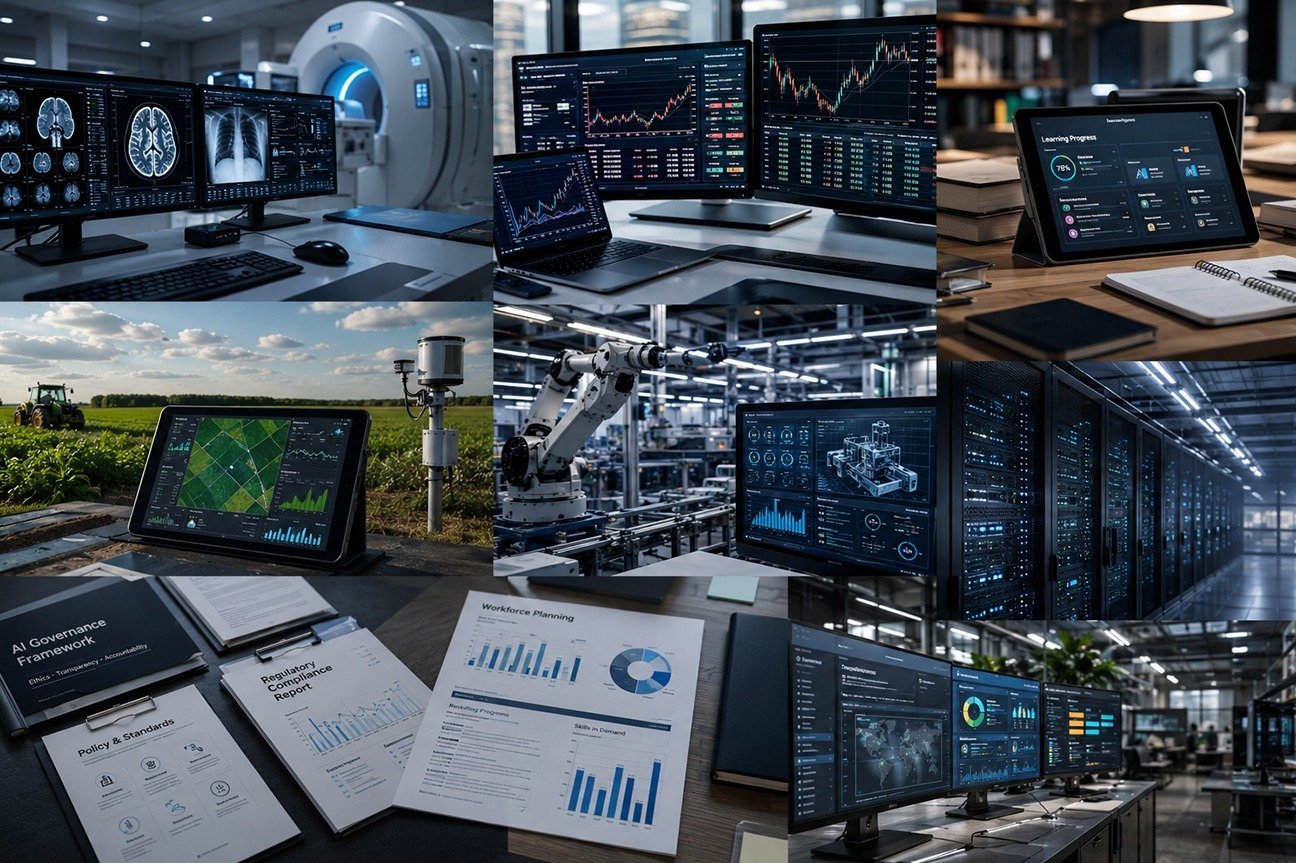
Unlike previous technological revolutions that unfolded gradually, AI is moving through every sector simultaneously. Healthcare systems now use AI-assisted diagnostics. Financial institutions rely on machine learning for fraud detection and compliance monitoring. Educational institutions are adopting adaptive learning systems, while manufacturers use predictive technologies to optimise production and reduce operational risk.
The scale of this transformation is measurable and already widely documented. PwC projects that AI could contribute up to 15.7 trillion dollars to the global economy by 2030 PwC Global AI Economic Impact. Goldman Sachs estimates that widespread AI adoption could raise global GDP by around 7% over the next decade. Goldman Sachs AI Impact on Global Growth. At the same time, the World Economic Forum’s Future of Jobs Report 2025 forecasts that while automation could displace around 92 million jobs, it is also expected to create approximately 170 million new roles globally, resulting in a net gain of 78 million positions, while about 39% of existing skills will require transformation by 2030. PwC’s AI Jobs Barometer 2025 further highlights that workers with AI-related skills are already seeing wage premiums of around 56% PwC AI Jobs Barometer
The transformation is already underway. The question is whether leaders, institutions, and governments are moving fast enough to manage it responsibly.
Healthcare Is Becoming Predictive And Intelligent
Healthcare is among the industries experiencing the deepest AI transformation. AI-assisted imaging systems can now analyse scans with remarkable precision, while automated transcription and coding systems are reducing administrative burden across hospitals and clinics.
McKinsey Global Institute estimates that AI could generate between $200 billion and $340 billion in annual savings in the US healthcare system through operational efficiencies and improved clinical workflows, while also accelerating drug discovery by reducing development timelines and enhancing predictive modelling capabilities
Beyond efficiency, AI has the potential to expand access to quality healthcare in underserved regions by extending diagnostic capabilities beyond major urban centres. The long-term implications for preventative care and early diagnosis are significant.
Finance Became One Of AI’s Earliest Proving Grounds
Financial services adopted AI earlier than many other industries, and the results are already visible. Banks globally continue investing billions into AI systems because the gains in efficiency, compliance, and fraud prevention are substantial.
Machine learning systems can now analyse millions of transactions in real time, identifying suspicious behaviour with speed impossible through manual oversight. AI-driven compliance systems are also transforming regulatory monitoring, reducing risk exposure in heavily regulated environments.
At the customer level, AI-powered financial tools are improving access to personalised advisory services that were once available only to premium clients.
The financial institutions likely to dominate the next decade will not necessarily be those with the largest capital reserves, but those most capable of combining human judgement with intelligent automation.
Education Is Entering The Age Of Personalised Learning
One of education’s longest-standing limitations has been the inability to deliver truly individualised instruction at scale. AI is beginning to change that.
Adaptive learning systems can analyse student performance, identify learning gaps, and personalise content delivery in real time. Early implementations across universities and vocational training environments are already reporting measurable improvements in student engagement and outcomes.
For workforce education and vocational training, AI-assisted assessment systems are also transforming how competencies are recognised and measured. Processes such as recognition of prior learning, historically slow and resource-intensive, are becoming more scalable through intelligent automation.
However, the benefits will only be realised if digital infrastructure and access remain equitable. Without thoughtful implementation, AI risks widening educational inequality rather than reducing it.
Manufacturing And Agriculture Are Becoming Data-Driven Industries
AI is reshaping not only digital sectors but also industries rooted in physical operations.
In manufacturing, predictive maintenance systems continuously monitor machinery, identifying performance issues before failures occur. This reduces downtime, improves efficiency, and lowers operational costs significantly.
Supply chains are also becoming more responsive through AI-driven forecasting and real-time optimisation. In agriculture, precision farming technologies are helping farmers optimise irrigation, fertiliser use, and crop forecasting through satellite imagery, weather modelling, and sensor analytics.
While automation will replace some traditional roles, entirely new categories of employment are emerging in robotics oversight, systems optimisation, and AI operations management.
The Workforce Is Being Redefined
The workforce implications of AI are substantial. The IMF estimates that nearly 40% of global jobs will be affected by AI in some capacity. Roles involving repetitive cognitive tasks face the greatest exposure to automation.
This transformation is also reflected in workforce and market projections. The World Economic Forum’s Future of Jobs 2025 report indicates that 77% of employers are planning AI-related workforce reskilling initiatives, underscoring how rapidly organisations are adapting to new skill demands. Market research projections suggest that the AI industry could exceed $800 billion in value by 2030, reflecting accelerating investment across sectors. Goldman Sachs research further estimates that approximately 300 million jobs globally are exposed to automation risk due to AI adoption. At the same time, the World Economic Forum projects a net positive shift in employment, with around 78 million additional jobs expected to be created by 2030 as new roles emerge alongside automation-driven displacement. This is why workforce investment has become a strategic necessity.
Governance And Ethics Will Define The Outcome
The benefits of AI will not be distributed evenly. Countries with stronger digital infrastructure, advanced research ecosystems, and aggressive AI investment strategies will capture disproportionate economic advantage.
At the same time, concerns around algorithmic bias, privacy, transparency, and concentration of technological power are becoming increasingly urgent. Governments globally are responding with new regulatory frameworks aimed at balancing innovation with accountability.
The challenge for leaders is no longer whether AI should be adopted. The challenge is whether it can be implemented responsibly, ethically, and sustainably.
Leadership Will Determine Whether AI Serves Humanity Well
Artificial intelligence is not fundamentally a technology story. It is a leadership story.
Organisations that navigate this transition successfully will be those that invest in workforce capability, ethical governance, and long-term strategic clarity. AI does not replace uniquely human qualities such as judgement, creativity, ethics, empathy, and adaptability. It replaces repetitive and process-driven work that machines can increasingly perform more efficiently.
The most successful organisations will not be those attempting to eliminate human involvement. They will be those who combine human intelligence with machine capability intelligently and responsibly.
The tide of AI is already moving across every industry and every economy. It will continue regardless of whether institutions feel prepared.
The defining question of this decade is not whether AI will reshape the world. It is whether leadership will evolve quickly enough to guide that transformation wisely.