
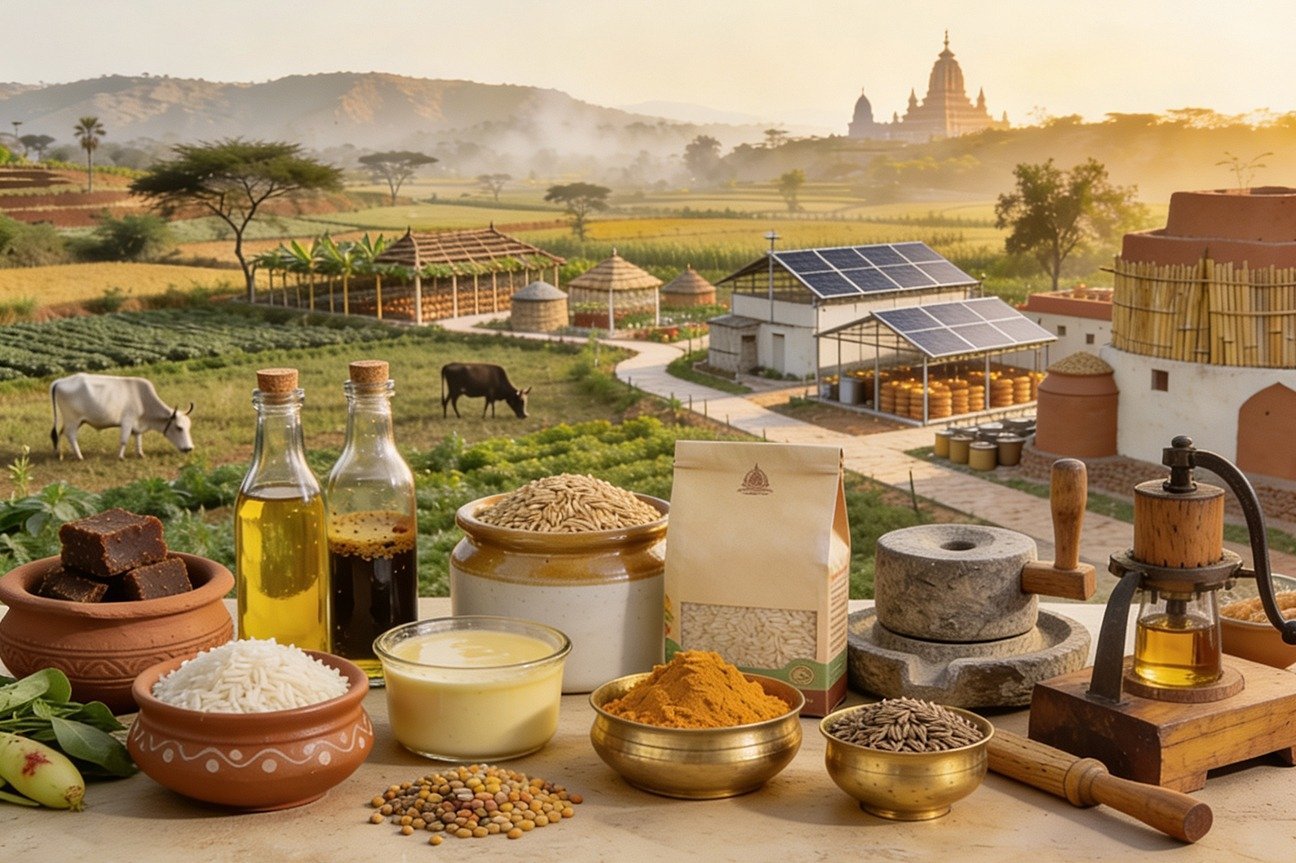
A Sattvik food startup is building the one thing legacy FMCG giants structurally cannot copy: a supply chain with nothing to hide.
Walk into any modern Indian kitchen, and something has quietly shifted. The pure ghee tin that sat on the shelf for a generation is being replaced by something the buyer can actually trace: a specific breed, a specific village, a specific process. The refined oil pouch is losing ground to cold-pressed bottles, where the seed, the press temperature, and the harvest batch all carry meaning. The question at the checkout counter has changed. It is no longer "what is the price?" It is "What is the story?"
This shift is not a niche consumer trend. It is a structural change in what the premium Indian food buyer considers trustworthy, and it is creating a gap that legacy brands, built for scale and standardisation, are not well-positioned to fill.
HariBol Foods was built specifically to fill it.
The Insight Most Premium Food Brands Missed
The last decade of Indian food startups largely chased the same five words: organic, natural, healthy, clean, and premium. The result is shelves so saturated with identical claims that they have stopped communicating anything. A consumer facing twelve "100% pure" ghee SKUs has no rational basis to differentiate them, so she defaults to habit or discount.
HariBol's founding insight was that the premium food consumer is not primarily searching for "healthier." She is searching for someone to trust. And in a country where food has carried sacred significance long before it became a wellness category, the most powerful trust signal is not a laboratory certificate. It is a tradition, paired with verifiable proof.
That is why the brand was built around the Sattvik framework rather than the wellness one. Sattvik is not a marketing label. It is an operating philosophy governing what is sourced, how it is processed, and what it does for the person consuming it. When that philosophy is genuinely embedded at the foundation, every decision downstream becomes consistent with it rather than in tension with it.
The Moat Legacy Brands Cannot Retrofit
The most structurally significant aspect of HariBol's model is what it does with its animals, and more precisely, what it refuses to do.
The dairy supply chain that underpins most of India's premium ghee shelf, including many brands marketed as natural or artisanal, operates on economics that include forced impregnation, calf separation, and disposal of animals once they stop producing. This is not a fringe practice. It is the default cost structure of industrial dairy.
HariBol's dairy operates on Ahimsa principles: non-violence, dignity, and lifetime care for animals. Milk is sourced only from surplus the calf has not consumed. This is not a label that can be added to an existing supply chain. It is a cost structure that requires acceptance at the root, which changes unit economics, supplier relationships, and throughput in ways that cannot be retrofitted onto an incumbent's existing infrastructure.
That is precisely why no legacy major has done it at scale. The barrier is not knowledge or willingness. It is that cruelty-free dairy, done genuinely, is incompatible with the economics that made the incumbents large.
To make the commitment verifiable rather than merely stated, cows are AI-tagged for continuous lifetime monitoring, turning animal welfare into logged data rather than a label promise. The company has received acknowledgement from the World Economic Forum for its integration of IoT and AI in food supply chains, and recognition from the Prime Minister's office for pioneering a cooperative model deploying IoT across its dairy ecosystem.
The Supply Chain That Took Years to Build
If Ahimsa is the philosophy, the farmer network is the infrastructure that makes it viable at scale. HariBol has integrated over 2,000 farmers across Gujarat, Maharashtra, Uttarakhand, and Himachal Pradesh directly into its supply chain.
Direct relationships of this depth and breadth take years to build. They cannot be acquired in a funding round or assembled through a procurement dashboard. For a D2C entrant, the capital requirements are prohibitive. For a legacy major, the model conflicts with the cost efficiencies their margins depend on. The result is a supply-side position that is genuinely difficult to replicate.
There is also a social dimension worth noting. By creating viable rural livelihoods in sustainable dairy and honey production, HariBol has contributed to reversing the pattern of youth migration from villages to cities, a policy priority with commercial resonance among institutional investors and government programmes funding India's next generation of rural enterprises.
A Channel Architecture Built for Multiple Consumer Moments
HariBol is currently stocked in over 1,000 modern retail outlets, including Reliance Retail, Nature's Basket, Metro, and Spencer's, alongside quick commerce platforms such as Blinkit and Zepto, e-commerce marketplaces including Amazon and BigBasket, and its own direct-to-consumer channel.
Each channel serves a distinct consumer moment: modern trade builds physical credibility and discovery; quick commerce captures the immediate refill; e-commerce owns the planned monthly purchase; D2C deepens relationships with the highest-value repeat buyers.
The channel that sits outside conventional FMCG strategy entirely is the most culturally specific: HariBol products are stocked in over 150 ISKCON temples globally. For a brand built on Sattvik principles, this is not an unusual distribution channel. It is the most native one possible, and not one that a competitor can enter by writing a cheque.
The Export Thesis: Sattvik as a Global Category
The international dimension of HariBol's strategy is where the longer-term ambition becomes visible.
The brand has an established presence in the United States through retail outlets and the temple network. A manufacturing facility focused on yogurt and ghee is planned for the US market. Products are available in the UK, and the UAE expansion is underway.
The addressable consumer here is not only the Indian diaspora. The global wellness buyer who pays premium prices for ceremonial-grade matcha, single-origin olive oil, and regeneratively farmed meat is the same buyer for whom traceable, ethically sourced, tradition-rooted food carries genuine purchasing weight. Sattvik, properly positioned and authenticated, is a category with global legs.
What the HariBol Model Actually Demonstrates
The temptation when writing about a brand with a strong story is to treat the story as the point. It is not. The story is the evidence. What the evidence points to is a more broadly applicable thesis about where the next decade of Indian consumer brands will be won.
It will not be won by the loudest "premium" claim. It will be won by founders who can answer, in a single sentence, why their product exists in a way no competitors can, and then build a supply chain, a distribution architecture, and a cultural positioning that makes that answer impossible to copy.
Sattvik food is a tradition with more history than any FMCG company currently on the shelf. The question HariBol has spent years answering is what it looks like to build a brand genuinely worthy of that tradition, at scale, with proof.
That question turns out to be a better business strategy than most.