
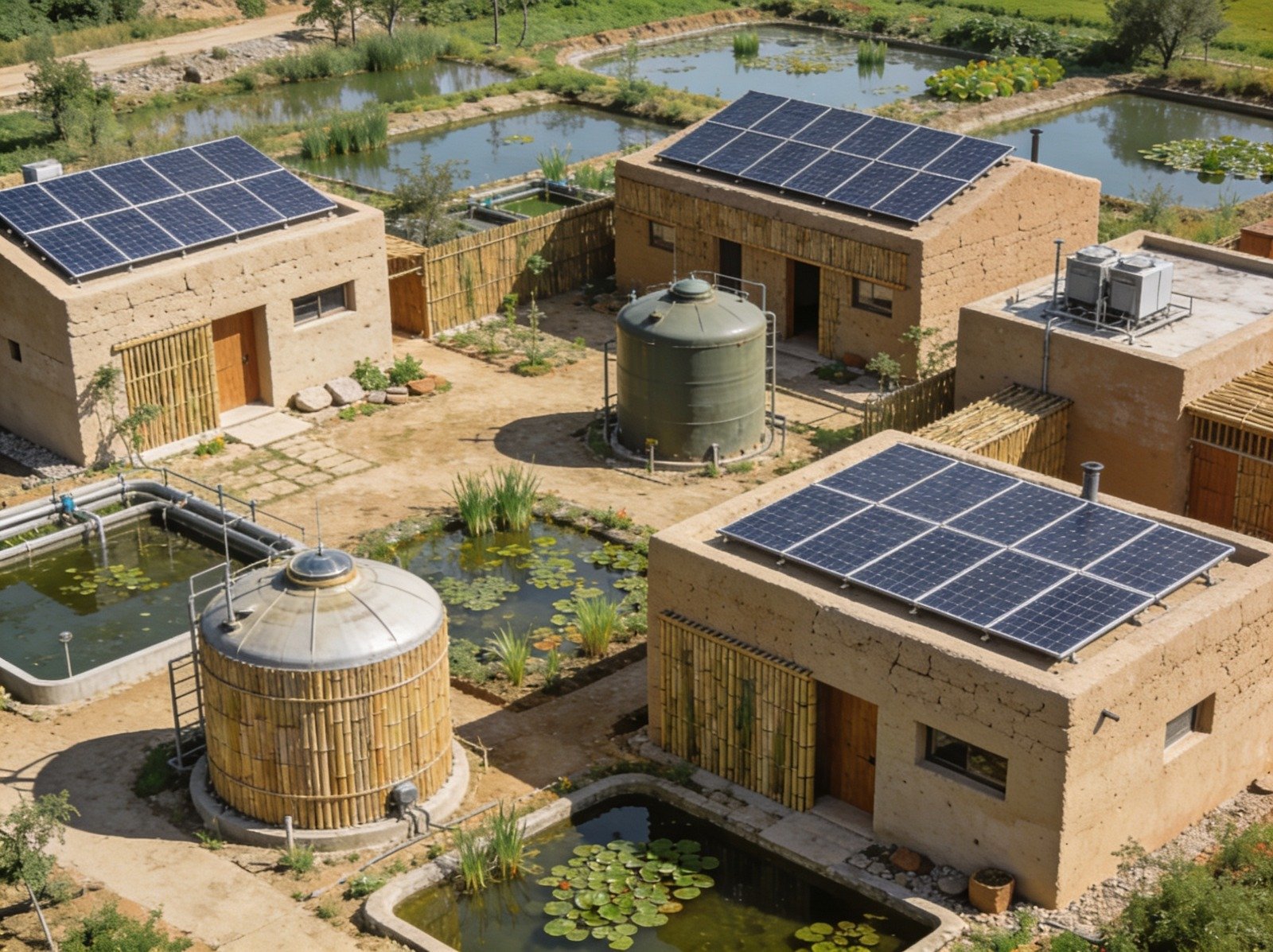
In one of Maharashtra's most underserved districts, a development model built on sustainability, community, and inner transformation is delivering outcomes that conventional approaches have failed to achieve.
Palghar district sits less than 150 kilometres from Mumbai, yet in many of its tribal interior talukas, the distance from basic opportunity feels far greater. With over a third of its population belonging to Scheduled Tribes, chronic malnutrition, seasonal migration, water scarcity despite high rainfall, and a per capita income of approximately Rs. 27,000 per annum, Palghar has long represented one of rural India's most layered development challenges.
What has emerged in this landscape over the past decade is worth serious attention, not as a feel-good story, but as a replicable model that challenges conventional assumptions about how rural transformation actually works.
Govardhan Eco Village (GEV), located in Palghar's tribal heartland, was not conceived as a development organisation. It began as a spiritual retreat. What it has become is something considerably more difficult to categorise, and considerably more instructive for anyone thinking about integrated community impact.
When Spiritual Purpose Becomes Operational Strategy
The instinct in development circles is to separate the spiritual from the strategic. GEV makes that separation impossible.
Operating on a principle its leadership calls S3 Impact, combining Spirituality, Sustainability, and Social Transformation, the institution has built an integrated rural development model across more than 200 villages. Its core conviction is that lasting change must address material progress, ecological balance, and inner well-being simultaneously. Strip any one of those three out, and the model weakens.
This is not language borrowed from a mission statement. It is reflected in what the numbers actually show.
Over 2,000 marginalised tribal farmers have transitioned from subsistence farming to diversified, sustainable livelihoods through orchard-based agroforestry, organic farming, and the revival of indigenous seeds. Training in climate-resilient practices has reduced input costs while improving food security. Distress migration, one of the most reliable indicators of a community's economic fragility, has measurably declined across participating villages.
The lesson for leaders is straightforward: when purpose is genuinely integrated into operations rather than mounted on a wall, it changes the decisions people make every day at every level of the organisation.
Water, Women, and the Infrastructure of Dignity
Two of GEV's most instructive programmes address the foundational conditions that most development efforts treat as background assumptions rather than primary targets.
On water: GEV has developed hundreds of water-harvesting structures across 50 villages, including ponds, well pits, irrigation systems, and rejuvenated canals. More than 13,000 villagers now have improved access to water. In a region where high rainfall coexisted with chronic water scarcity, this required not imported technology but community-led stewardship of existing resources. The insight is applicable well beyond agriculture: most scarcity problems are distribution and governance problems before they are resource problems.
On women: Over 3,300 women have been organised into Self-Help Groups, trained in micro-enterprises, and connected to market access. Collectively, they have generated over Rs. 2 crore in income. The more significant outcome, however, is not financial. These programmes have shifted decision-making power within households and communities, creating a compounding social return that income figures alone cannot capture.
The organisations that generate durable community impact consistently share one characteristic: they treat the people they serve as participants in a system, not recipients of a service.
Feeding the Ecosystem: Nutrition, Health, and Skills
In 2018, GEV launched Annakshetra, a nutrition initiative that has since distributed over 7 million meals to vulnerable communities. The downstream effects extend well beyond hunger relief. School attendance has improved. Families have redirected spending toward education and healthcare. The initiative demonstrates something that every systems thinker understands, but few programmes are built to exploit: solving one problem well creates the conditions for solving several others.
On healthcare, GEV has extended access to free and subsidised medical care, including cataract surgeries, dialysis, and cancer treatment, into remote tribal areas through mobile health units and community outreach supported by Bhaktivedanta Hospital. It has integrated Ayurveda and Yoga alongside modern medicine, not as an ideological position, but as a practical response to the conditions and cultural context of the communities it serves.
On youth employment, the Govardhan Skill Centre has trained over 3,000 young people in vocational and technical skills, with placement linkages that connect training directly to employment. Of particular significance: 30 tribal girls have been placed in skilled industrial roles, a milestone that carries disproportionate meaning in a region where such pathways have historically been closed.
Sustainability as Infrastructure, Not Ideology
GEV operates as a net-zero eco-village. Renewable energy systems, water conservation, waste-to-resource practices, and green infrastructure are not supplementary features. They are the operating foundation.
Biodiversity conservation, including the preservation of indigenous seeds and the restoration of degraded ecosystems, reinforces a principle that is gaining currency in both environmental and business circles: traditional knowledge, when taken seriously rather than romanticised, offers practical and often superior solutions to modern challenges.
GEV has attracted international recognition as a model for sustainable rural development. It draws over one million visitors annually to its 100-plus-acre campus, functioning simultaneously as a spiritual destination, an educational hub, and a living demonstration site. The fact that it sustains this scale while remaining financially viable and community-rooted is, in itself, a case study in organisational design
The Model's Next Chapter
Looking ahead, GEV is expanding through several significant initiatives: a 100-bed hospital with a focus on maternal and child health, a 650-student school, an integrated Ayurveda and wellness centre, senior living facilities, and livelihood programmes in handloom and Sattvic culinary training.
Each of these represents not an addition to the existing model, but a deepening of it. The architecture remains consistent: address health, education, livelihoods, environment, and inner development as an integrated whole rather than as parallel programmes that happen to share a geography.
What This Means Beyond Palghar
The question GEV implicitly poses to leaders, whether in business, government, or civil society, is a genuinely challenging one: what would it look like to build an institution where the spiritual, the ecological, and the economic were not competing priorities but the same priority expressed through different means?
Most organisations are structured to optimise one dimension at the expense of the others. GEV has spent a decade demonstrating that the trade-off is not as necessary as it appears.
In an era where development challenges are increasingly interconnected and conventional models increasingly inadequate, that demonstration has value that extends well beyond one district in Maharashtra.
Govardhan Eco Village is not a perfect institution. No institution is. But as a model for what integrated, purpose-rooted community transformation can produce, it deserves a closer look than most leadership conversations have yet given it.