
There is a question that haunts every serious leader at some point in their journey: Am I making this decision from wisdom, or from fear?
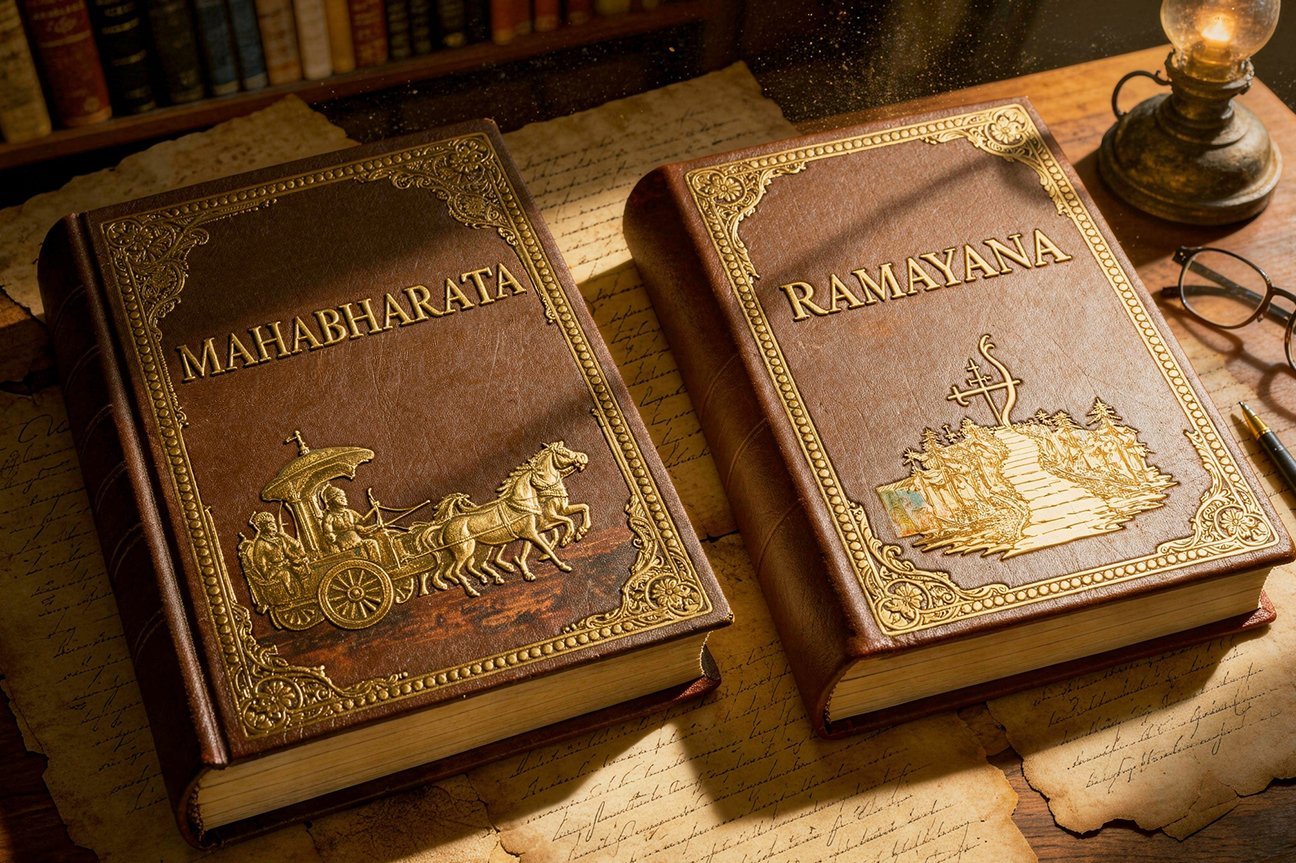
It sounds like a modern dilemma, the kind debated in boardrooms and business schools. But it was answered, with startling precision, by two texts composed millennia ago: the Mahabharata and the Ramayana. Read them not as sacred scripture, but as leadership case studies. What you find will be uncomfortable, useful, and remarkably current.
The Whisper Before the Crisis
In the Ramayana, the exile of Ram, which destabilised an empire, broke a king, and ignited a decade of war, was not caused by an army or a political coup. It was caused by a whisper.
Manthara, a handmaid, planted a single seed of doubt in Queen Kaikeyi's mind: If Ram becomes king, your son will be nothing. You will be forgotten. Kaikeyi resisted at first. But Manthara was patient, watering the seed with fear, invoking old promises, magnifying insecurities, until love transformed into anxiety, and anxiety into a demand that could not be undone. The result? An empire destabilised. A king dead of grief. A prince exiled to the forest.
This is not mythology. This is organisational behaviour playing out in a different era.
The most dangerous threats to any institution rarely arrive in armour. They arrive as whispers, in performance reviews laced with innuendo, in conversations that plant comparison, in the quiet internal voice that says: you are not enough, you must act now or lose everything.
The Ramayana's instruction to leaders is not to prevent whispers. They are inevitable in every organisation. It is to build the self-awareness to interrogate the source of your decisions before acting on them. Before you move, ask: is this clarity, or is this fear wearing the costume of urgency?
Consciousness Is the Real Capital
The Mahabharata opens by refusing to answer questions about its own origins directly. Instead, it does something more useful: it invites you to read yourself into it.
When Dhritarashtra, Pandu, and Vidura were born to mothers receiving the same sage, the outcome was shaped entirely by the internal state each mother brought to the moment. Ambika shut her eyes in fear. Ambalika's face turned pale in anxiety. The unnamed handmaid, lowest in rank, absent from the court's consideration, served with open eyes and a willing heart. From her was born Vidura: the wisest, most uncorrupted mind in the entire epic.
It was not bloodline, title, or position that determined what each became. It was the quality of consciousness brought to the moment of engagement.
In every organisation, there is always a Vidura, a person without the loudest title or the largest office, whose thinking is clearest precisely because it is undistorted by the fear of losing what they do not have. The question every leader must ask is not who holds rank, but who holds clarity. Are you investing in hierarchy or in consciousness?
Purpose Before Strategy
The Ramayana describes four reasons for Ram's presence in the world: to defeat injustice, to protect those devoted to learning, to honour a bond of devotion, and to restore a sacred order. Not one was self-serving. Every purpose was oriented outward, toward a tension in the world that needed resolving.
This is the architecture of leadership that endures. The most consequential leaders in any era are not those who accumulate authority for its own sake, but those whose existence addresses something the world genuinely needs. They arrive because they are required, not because they sought the stage.
Before you define your strategy or your five-year plan, define your purpose. Not the polished corporate version, but the true one. What tension in the world does your organisation exist to resolve? The answer to that question is worth more than any roadmap built without it.
Great Governance Is Always a Team Sport
There is a detail in the Ramayana that most retellings overlook: Dasharatha's eight ministers were not ceremonial. Each held a distinct mandate covering military strategy, intelligence, economic stewardship, public grievance, and diplomatic counsel. Each was empowered to challenge even decisions touching the king's own family when dharma demanded it.
The result was Ayodhya, described as a city with no hunger, no injustice, and no unchecked fear. Not because the king was perfect, but because the system around him was built on accountability, competence, and the clear supremacy of the public good over personal interest.
Ramarajya was not the product of one extraordinary individual. It was the product of an extraordinary team united not by loyalty to the king, but by loyalty to something larger than any one of them.
Modern leadership research has arrived, slowly and through considerable difficulty, at the same insight: psychological safety, functional diversity, distributed accountability. These are the foundations of resilient organisations. The Ramayana encoded this truth thousands of years before it had a name.
Service Without a Ledger
Of all the figures in the Ramayana, Lakshmana offers perhaps the most quietly revolutionary leadership model. When Ram was sent to the forest, Lakshmana did not negotiate. He did not calculate the cost. He said simply: I cannot leave you. And for fourteen years, he did not, building shelters, standing guard through the night, asking for nothing in return.
Ram said of his brother: With Lakshmana beside me, I do not miss my father.
That is the measure of what unconditional service produces. Not subordination, but the deepest form of trust.
Lakshmana was not a subordinate performing a duty. He was a presence, full, unwavering, and entirely without transaction. He gave not because it served him, but because serving was simply who he was.
In a professional world where every relationship is quietly optimised for personal return, where ROI is calculated on mentorship and visibility is weighed before generosity, the Lakshmana model sounds almost naïve. But the leaders who build lasting culture, lasting loyalty, and lasting impact are almost always those who have learned to give without keeping score. Rarity commands value, in markets and in leadership alike.
The Mirror You Have Been Avoiding
The Mahabharata contains a statement that has survived thousands of years because it is simply true: Whatever is here may be found elsewhere. What is not here cannot be found anywhere.
It is telling us something essential. These epics are not accounts of distant heroes in a vanished world. They are precise maps of the interior landscape every leader inhabits, the tensions between duty and desire, power and purpose, fear and clarity.
The question is not whether these stories are historically verifiable. The question is whether you are willing to sit with them long enough to recognise yourself in them. In Kaikeyi's fear. In Dhritarashtra's blindness. In Lakshmana's devotion. In the unnamed handmaid who served with her eyes open and produced the wisest man in the room.
Because in that recognition, something shifts. Not inspiration, but something more durable. Clarity about the kind of leader you are, and the kind you still have the choice to become.
The mirror has always been there. The only question is whether you are willing to look.