
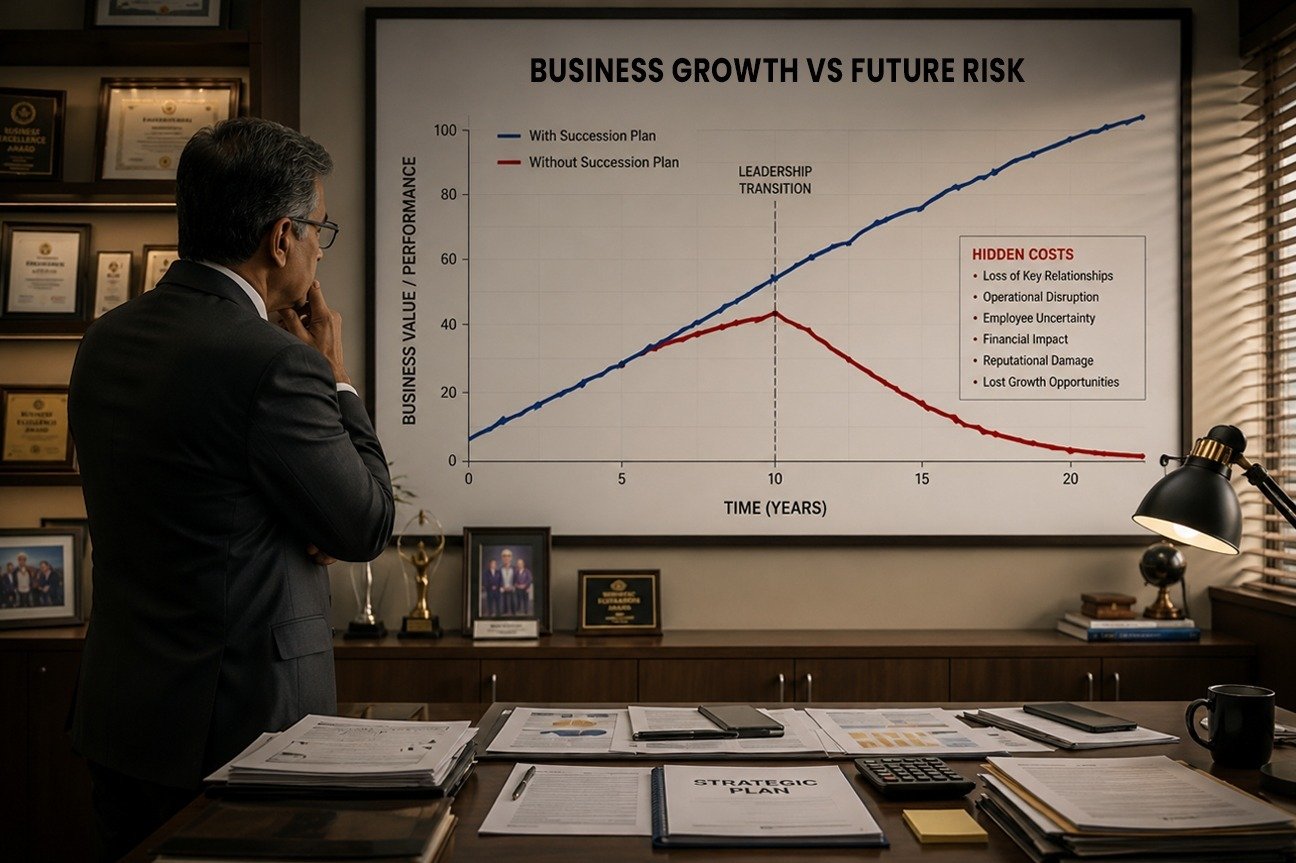
Most small and mid-sized businesses are built on the shoulders of one person. When that person leaves, voluntarily or not, the enterprise they spent decades building can unravel in months. The silence around succession planning is costing SMEs everything.
When Jack Ma stepped away from Alibaba, it was planned years in advance, a meticulous choreography of leadership transition that the company's communications team had rehearsed and the board had sanctioned. When most SME founders leave, it looks nothing like that. It looks like a phone that stops being answered, a key-man clause being triggered in a loan agreement, and a management team that suddenly realizes the institutional knowledge walked out the door along with the founder.
Succession planning remains one of the most consistently avoided conversations in small and mid-sized business ownership. The reasons are human: confronting succession forces a founder to reckon with mortality, irrelevance, and the uncomfortable reality that the business they built might run just fine without them, or might not run at all. Both prospects are unsettling. So the conversation gets deferred. And deferred again. Until it is too late.
The Illusion of the Irreplaceable Founder
Most SMEs are structurally built around their founders in ways that feel natural during growth but become catastrophic during transition. Client relationships are personal. Vendor negotiations happen over dinner. Credit lines are secured by individual signatures. Institutional knowledge, pricing logic, key hiring judgments, and the reason a particular partnership was avoided exist entirely in one person's head.
According to a landmark study by PricewaterhouseCoopers, only 23% of family businesses have a robust, documented succession plan. The remaining 77% operate on a spectrum between vague intention and complete avoidance. For these businesses, the founder is not just the leader. They are the load-bearing walls. What makes this especially precarious is that the dependency becomes deeper over time. Every year of growth that flows through a single person's relationships, decisions, and reputation makes the eventual transition harder, not easier.
What the Exit Actually Costs
The costs of an unplanned founder exit are rarely captured in a single line on a balance sheet. They cascade. Poorly managed leadership transitions often create operational disruption, uncertainty, and performance decline. McKinsey research found that many businesses underperform following CEO succession, with declines visible across revenue growth and overall business performance. For SMEs with limited financial buffers, such instability can be deeply damaging.
The impact of an unplanned founder exit spreads quickly across the business. Client relationships weaken, employee confidence declines, decision-making slows, and financial pressure increases as uncertainty grows. What begins as a leadership gap can rapidly become an operational and financial crisis.
Founder dependency also affects business valuation. Investors and buyers often discount businesses that rely too heavily on one individual, particularly when revenue generation, client relationships, and decision-making remain concentrated with the founder. A business that might otherwise command a strong EBITDA multiple can see its valuation decline significantly, not because the business lacks potential, but because it was never structured to operate independently of its creator. In these situations, the founder’s presence becomes a structural risk that buyers and investors price aggressively into the deal.
Why SMEs Keep Avoiding It
The avoidance is not irrational. Succession planning requires founders to do several things that feel psychologically threatening simultaneously: acknowledge their own impermanence, identify leaders who might one day surpass them, and document knowledge they may have kept proprietary as a form of job security, even unconsciously. The business, for many founders, is not just a financial asset. It is identity. Planning its transfer can feel like planning one's own disappearance.
There is also a structural problem. Most SME founders lack the board governance, HR infrastructure, or access to advisors that large enterprises use to institutionalize succession planning. In a well-resourced corporation, the board demands a succession pipeline as a matter of fiduciary discipline. In an SME, there often is no board. The founder is the board. And the founder is not inclined to plan their own obsolescence.
In many growing businesses, founders become increasingly central to operations and decision-making over time. As this dependency deepens, leadership transitions become more difficult, often making succession planning complex and disruptive when not addressed early.
The True Scale of the Problem
As many business founders approach retirement, a growing number of organisations are entering critical ownership and leadership transitions without adequate succession planning in place. While some businesses successfully navigate these changes, many struggle with operational disruption, leadership gaps, and long-term instability.
Research on family and founder-led enterprises consistently shows that businesses often fail not because of weak products or poor market demand, but because transition planning begins too late or remains too dependent on a single individual.
What becomes clear across succession research is that long-term continuity is rarely accidental. Businesses that transition successfully are typically those where founders made a deliberate effort to build systems, develop future leaders, and reduce dependency on themselves well before a transition became necessary.
The Businesses That Get It Right
Succession planning done well is not a dramatic event. It is a decade-long process of deliberate delegation, documentation, and leadership development. The firms that navigate founder exits cleanly tend to share several characteristics: they have written operating procedures that would allow a competent outsider to understand the business; they have developed at least one internal leader with genuine profit-and-loss ownership experience; they have diversified client relationships beyond the founder's personal network; and they have held at minimum one honest conversation with their legal and financial advisors about what a transition would structurally require.
Deloitte’s research on family enterprises consistently highlights that successful succession planning is built through early preparation, gradual leadership development, and active involvement of future leaders long before a transition takes place. Organisations that treat succession as an ongoing strategic process rather than a last-minute event are generally better positioned for continuity and long-term stability.
The Conversation Every Founder Needs to Have
The true strength of a business is not measured by how indispensable its founder becomes, but by how effectively the business can continue to operate, grow, and adapt without constant dependence on one individual. Many founders spend years building successful organisations, yet unintentionally create structures where critical knowledge, decision-making, and leadership remain too concentrated in themselves. Over time, this makes the business increasingly fragile, regardless of its financial success or market position.
Succession planning is therefore not simply about retirement, ownership transfer, or preparing for an eventual exit. It is a long-term leadership responsibility rooted in sustainability, continuity, and resilience. Businesses that endure across generations are rarely built through short-term success alone. They are built through deliberate efforts to develop future leaders, document knowledge, strengthen systems, and create an organisation capable of functioning beyond the founder’s direct involvement.
Ultimately, the legacy of a founder is not defined only by what they build during their time leading the business, but by whether the business remains strong after they step away from it.