
The leaders who will define the next decade are not those who deploy the most AI. They are the ones who know what AI cannot replace and build deliberately around it.
There is a paradox sitting quietly at the centre of every boardroom conversation about AI in 2026. The technology capable of automating analysis, generating strategy options, accelerating product development, and processing more information in a second than most teams can in a week, is simultaneously exposing the irreplaceable value of the things it cannot do. Empathy. Judgment under genuine ambiguity. The ability to inspire trust. The courage to make a consequential call when the data points in two directions at once.
The future of digital leadership is not a story about AI replacing human leadership. It is a story about the leaders who understand that distinction and build organisations capable of combining both pulling decisively ahead of those who do not.
From Pilots To Performance: The AI Imperative Is Real
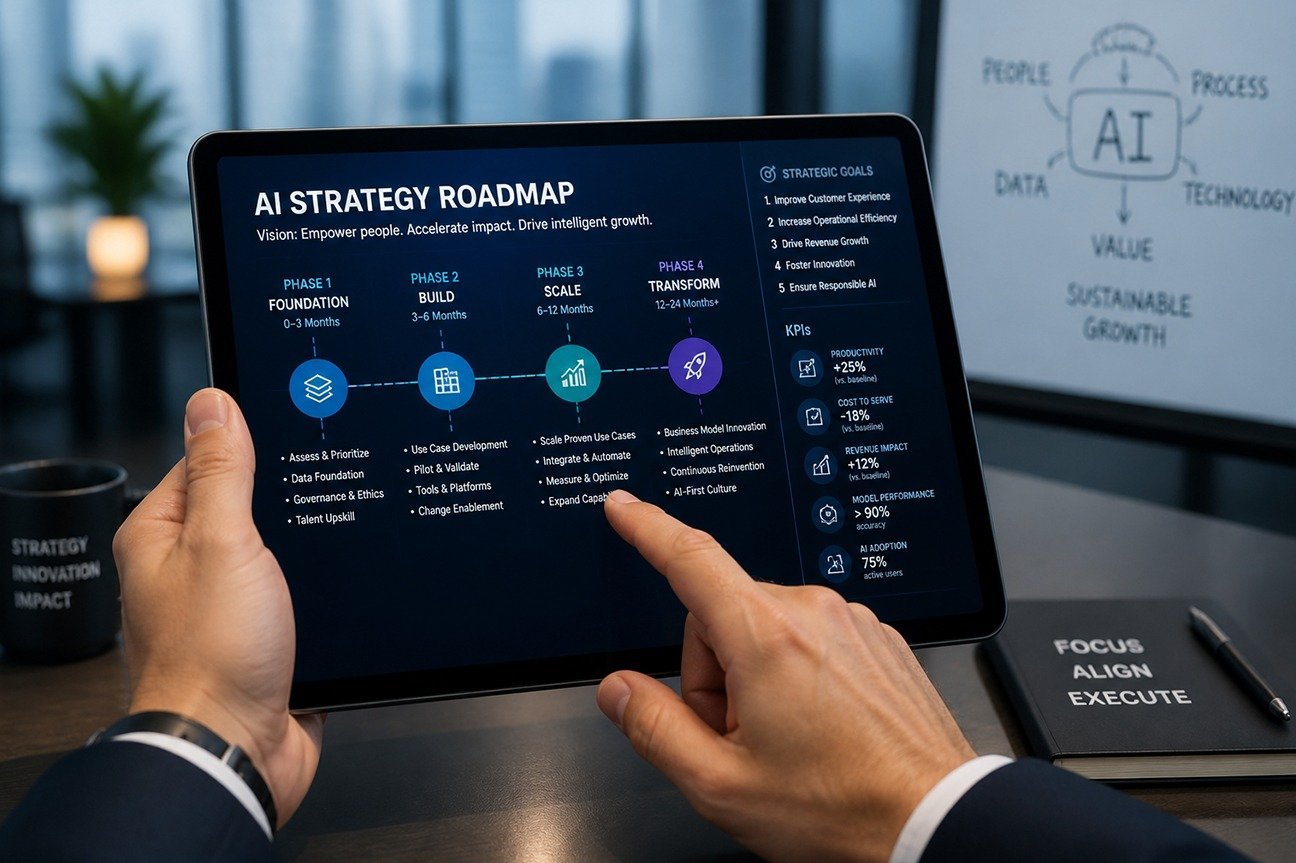
Organizations can no longer afford to treat AI as a limited experiment or isolated innovation initiative. AI is rapidly becoming a core driver of business performance, influencing growth, efficiency, competitiveness, and long-term resilience. The gap between organizations that successfully integrate AI into their operations and those that do not continues to widen.
As AI moves from technical teams into broader business strategy, leadership involvement becomes increasingly important. Decisions about investment, workforce planning, operating models, and innovation are now closely tied to how effectively organizations adopt and scale AI capabilities. Success depends not only on technology implementation but also on the ability to align AI with business objectives and measurable outcomes.
At the same time, organizations are recognizing that transformation cannot happen in isolation. Collaboration, partnerships, and ecosystem thinking are becoming essential for building the capabilities needed to compete in an AI-driven environment. The focus is shifting from experimentation to execution, and from pilots to sustained business performance.
The Execution Gap That Is Costing Leaders Their Advantage
While organizations continue to increase their AI investments, many still struggle to translate ambition into sustained business results. The challenge is often not technology adoption itself, but the organizational readiness required to scale AI effectively. Success depends on more than deploying new tools it requires changes in leadership, talent, decision-making, and operating models.
Organizations that close this execution gap treat AI as a business transformation rather than a technology initiative. They align AI efforts with strategic priorities, establish clear governance while maintaining agility, and focus on areas where AI can create meaningful impact. By redesigning processes around AI rather than simply adding technology to existing workflows, they are better positioned to generate long-term value and competitive advantage.
The difference between leaders and laggards increasingly lies in execution. As AI becomes more deeply embedded across the enterprise, organizations that can adapt quickly, build workforce capabilities, and integrate AI into everyday operations will be better equipped to capture its full value. In an environment where technological advantages can be replicated, the ability to execute effectively becomes a lasting source of differentiation.
The Human Edge: What No Model Can Replicate
The most important insight in the current AI conversation and the one most consistently underweighted by organisations focused primarily on deployment speed, is that AI's rise does not diminish the value of human leadership. It amplifies it. The premium on the things AI cannot do is rising, not falling, precisely because AI is taking over more of what it can.
Gartner predicts that 40% of enterprise applications will integrate task-specific AI agents by the end of 2026, up from less than 5% in 2025. As agentic AI systems increasingly plan and execute complex tasks autonomously, the leadership capabilities that cannot be automated, such as ethical judgment, emotional intelligence, genuine human connection, creative synthesis, and the capacity to hold an organisation's purpose steady through disruption, become the scarcest and most valuable resources an organisation possesses.
This is not a soft observation. It is a strategic one. The leaders and organisations that invest in human capability alongside AI capability that build cultures where empathy, trust, and authentic accountability are as deliberately developed as technical fluency are building something that AI cannot replicate, and competitors cannot easily copy. A technology advantage can be purchased. A cultural advantage must be earned, and it compounds over time in ways that balance sheets rarely capture until the gap becomes undeniable.
KPMG's CEO Outlook found that 79% of business leaders worldwide believe that integrating AI into their organisations has led them to fundamentally rethink how employees are trained and their skills developed. The leaders getting this right are not asking "how do we train people to use AI?" They are asking the more important question: "How do we develop the distinctly human capabilities that make AI more valuable and that remain essential when AI reaches its limits?"
Digital Leadership As A Cultural Commitment
The organisations that will define the next decade of digital leadership are not primarily distinguished by which AI models they deploy or how much they spend on technology infrastructure. They are distinguished by the clarity of their strategic intent, the quality of their human-AI operating model, and the depth of the cultural commitment that holds both together.
Digital leadership in 2026 and beyond requires a simultaneous capacity for speed and judgment, moving quickly enough to capture the advantages AI makes available, while maintaining the human oversight, ethical clarity, and long-term thinking that prevent those advantages from creating new categories of risk. It requires leaders who are fluent enough in AI to ask the right questions of it, and human enough to know which questions it cannot answer.
It requires, above all, a commitment to growth that is not merely financial but human-centered in the most practical sense: building organisations where technology serves people, where innovation is anchored to purpose, and where the leaders at the top model the integration of capability and character that the era demands.
The leaders who navigate this well will not be remembered for the AI they deployed. They will be remembered for what they built with it and for how they kept the human at the centre of it all.