
There is a conversation I hear regularly in the clinic.
“We’ve tried everything. Physio for a year. Then a chiropractor. The curve is still getting worse.”
The parent opens a folder of X-rays. The Cobb angle at the start of treatment was 24 degrees. The Cobb angle now is 31 degrees. Both practitioners stated they were doing everything correctly.
In many cases, they were within the limits of what they were trained to do. The issue is not effort or negligence. It is methodology. Specifically, the methodology was never built for scoliosis.
Two Professions, One Shared Blind Spot
Generic physiotherapy was developed to address broad musculoskeletal dysfunction, strengthening, mobility restoration, pain reduction, and postural rehabilitation. These principles work well for sports injuries, chronic back pain, postural discomfort, and post-surgical recovery.
Generic chiropractic focuses primarily on joint manipulation and spinal mobilisation, reducing nerve irritation, restoring segmental motion, and improving alignment within the sagittal and coronal planes.
Both disciplines offer real clinical value in the right context.
Scoliosis is not in that context.
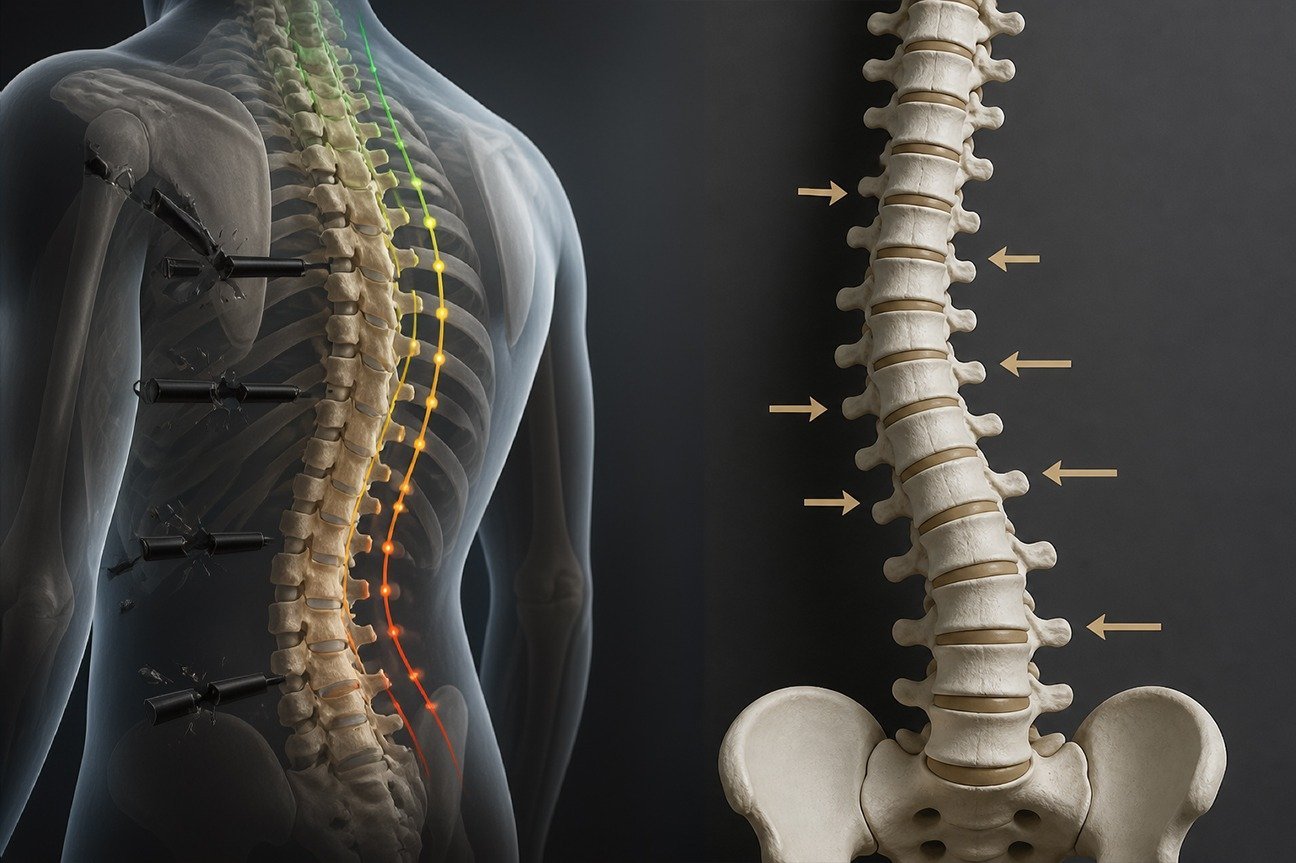
Adolescent idiopathic scoliosis is a three-dimensional spinal deformity: lateral curvature, vertebral rotation, and disruption of the spine’s natural sagittal profile, all occurring simultaneously and interacting continuously. Neither standard physiotherapy protocols nor conventional chiropractic manipulation were designed around this three-dimensional biomechanical reality.
The Three-Dimensional Problem: Generic Approaches Miss
Most standard physiotherapy programmes focus on movement in the sagittal plane, the forward-and-backward mechanics of the body. Core strengthening, lumbar stabilisation, and spinal extension exercises largely operate within this framework.
Conventional chiropractic adjustments address segmental joint restriction and aim to restore spinal mobility, but they are typically applied without corrective loading specific to the patient’s curve geometry.
Scoliosis demands more.
In the coronal plane, scoliosis creates lateral curvature. In the transverse plane, it causes vertebral rotation and rib prominence. In the sagittal plane, reduced thoracic kyphosis or flat back may occur.
In all three planes, these changes are interconnected and must be addressed together. Generic approaches may improve function but often fail to correct structural and rotational imbalance if not individually tailored.
This is not a criticism of the practitioners. It is a limitation of the protocols.
What Scoliosis-Specific Care Actually Looks Like
Scoliosis-specific exercise (SSE) methodologies represent a significant step forward from generic care. Methods such as the Schroth Method and SEAS (Scientific Exercise Approach to Scoliosis) are built around the patient’s exact curve geometry and incorporate:
• Active self-correction of spinal alignment
• Rotational breathing techniques targeting the deformed thorax
• Neuromuscular retraining of asymmetrical loading patterns
• Stabilisation of corrected posture
• Integration of correction into daily movement
These approaches are credible, evidence-based, and categorically superior to generic physiotherapy for scoliosis. They are, however, exercise-only protocols. Their mechanism of spinal elongation depends entirely on the patient’s own neuromuscular effort, which the patient can actively generate through corrective posture, breath, and movement.
That is a meaningful ceiling.
The ScolioLife® Method: Beyond Exercise-Only Protocols
The ScolioLife® Method is built on the same scoliosis-specific principles as Schroth and SEAS: individualised three-dimensional correction, rotational breathing, and neuromuscular retraining. But it does not stop at exercise.
Where exercise-only protocols rely on the patient’s active effort to create spinal length, the ScolioLife® Method integrates advanced medical devices that apply passive mechanical elongation forces that the patient cannot generate through exercise alone. These include:
• ScolioEase - a scoliosis-specific device that applies targeted decompressive forces to the curve apex, facilitating spinal elongation during corrective exercise
• Vertetrac - a mechanical traction system designed to create intersegmental spinal distraction, reducing compressive loading on the concave side of the curve
• Decompression Tables - used to apply axial traction and spinal unloading, creating the conditions for improved disc hydration and spinal length that exercise alone cannot achieve
These devices do not replace the exercise component. They expand what is possible within it. Mechanically decompressing the spine before and during corrective exercise allows the patient to work in a position of greater spinal length, improving the corrective effect of the exercise itself.
The ScolioAlign® brace extends this principle into the hours between clinic sessions. Unlike passive braces designed solely to hold the spine in position, the ScolioAlign® applies hyper-corrective three-dimensional forces that both elongate and de-rotate the spine, reinforcing the corrective work of the clinic throughout the patient’s daily life.
Right thoracic, lumbar, and double-major curves each need different corrective strategies. The ScolioLife® Method customises bracing, exercises, and breathing work to the exact curve pattern. This level of precision is not achievable with generic physiotherapy or standard scoliosis protocols.
What the Research Shows
The evidence base for scoliosis-specific exercise has strengthened considerably over the past decade. A 2016 randomised controlled trial by Monticone et al. published in the European Spine Journal compared SSE to generic physiotherapy in patients with AIS and found significantly greater improvements in Cobb angle, trunk rotation, and quality of life measures in the SSE group. Multiple systematic reviews and meta-analyses have since confirmed the superiority of curve-specific exercise over generic physiotherapy for reducing Cobb angle progression in skeletally immature patients.
The SOSORT 2016 clinical guidelines explicitly recommend scoliosis-specific exercise over generic physiotherapy and state that SSE should be considered the standard conservative intervention for curves that do not yet meet bracing thresholds.
What is striking is not that this evidence exists. It is that so many patients continue to receive generic physiotherapy years after this evidence became available, not because their clinicians are negligent, but because SSE training remains specialised, access is limited, and the institutional infrastructure of most healthcare systems defaults to generic protocols.
The Real Cost of the Generic Default
The clinical cost of defaulting to generic care for scoliosis is measured in curves that progressed during treatment, in patients who completed years of exercise or manipulation without meaningful corrective benefit, and in families who were told they were doing everything possible when, in fact, the most effective intervention available was not being offered.
The psychological cost is harder to quantify but equally real. Adolescents who commit to a physiotherapy or chiropractic programme for twelve or eighteen months and watch their curve continue to worsen do not just lose clinical ground. They lose trust in the treatment process. When they eventually access scoliosis-specific care, they carry with them a learned scepticism that makes engagement harder and compliance more difficult to sustain.
Raising the Standard
What the scoliosis field needs is not a minor adjustment to existing practice. It needs a recalibration of the minimum standard.
Generic physiotherapy and conventional chiropractic should no longer be considered adequate primary interventions for adolescent idiopathic scoliosis in patients with progressive curves or those at risk of progression. The evidence does not support it, and the available alternatives are demonstrably superior.
The minimum standard should be curve-specific, three-dimensional corrective exercise designed for the individual patient’s curve geometry, delivered by a practitioner trained in SSE methodology, and reviewed regularly against objective clinical measures. At ScolioLife®, we combine the hyper-corrective ScolioAlign® brace with the ScolioLife® Method of exercises, customised routines tailored to your exact curve.
The gap between what patients are receiving and what the evidence supports is real. Closing it starts with naming it clearly.