
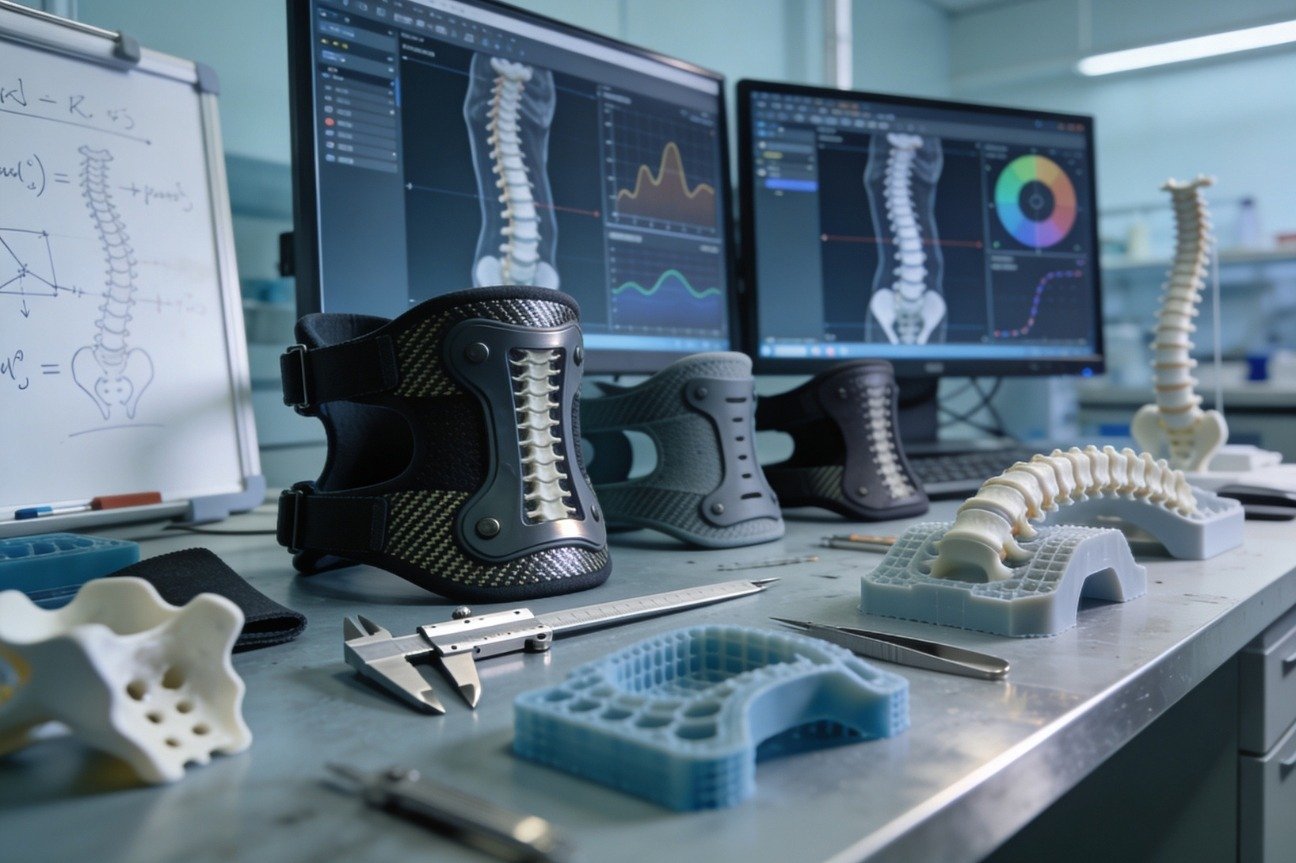
The debate in scoliosis care is no longer centred on whether bracing works. The more important question is whether the right bracing philosophy is being applied with the right goals, at the right stage of progression.
Ask most people to picture a scoliosis brace, and they will describe something that sounds closer to medieval armour than modern medicine. A rigid plastic shell. Hot and uncomfortable. Worn under clothing for twenty-three hours a day. Something a teenager endures with quiet humiliation rather than chooses with confidence. Something that, after years of wear, leaves the spine more or less where it started, merely prevented from getting worse.
This image is not imaginary. It is accurate for braces designed between the 1940s and the 1970s. The Milwaukee brace, introduced in 1945, and the Boston brace, developed in 1972, became the clinical workhorses of scoliosis management for decades. Their legacy shaped how an entire profession came to think about what bracing could and could not achieve.
That legacy is now becoming a limitation.
The Fundamental Problem With Legacy Brace Design
The Boston and Milwaukee braces were never designed to correct scoliosis. They were designed to contain it.
This distinction is critical. Containment bracing applies pressure to halt the progression of a curve that already exists. Its clinical objective is stabilisation, keeping the Cobb angle from worsening until skeletal maturity, when progression risk typically declines, and the brace can be discontinued.
By that standard, legacy bracing achieved partial success. The BRAIST trial, published in the New England Journal of Medicine in 2013, confirmed that bracing reduced the likelihood of curve progression to the surgical threshold. That represented important progress for scoliosis care. But the trial also revealed the limitations of the containment model. Even in the highest-performing bracing group, many patients still progressed, and none of the study’s success criteria focused on actual curve reduction. The objective was preventing deterioration, not achieving correction.
For years, that ceiling became accepted as the best possible outcome. Families were told that stabilisation was a success.
For patients presenting during peak growth velocity, while the spine still retains structural flexibility, that expectation is no longer sufficient.
The Shift to Hyper-Corrective Philosophy
Hyper-corrective bracing is based on a key clinical principle: the spine, especially in growing patients, is still adaptable and responsive to corrective forces.
In skeletally immature patients, open growth plates, flexible discs, and developing musculature create a critical window where spinal alignment can be guided rather than only stabilised. Hyper-corrective braces use this period to apply precise three-dimensional forces that address lateral curvature, rotation, and imbalance together.
Unlike traditional braces that mainly aim to prevent progression, these systems actively work toward correction. Their effectiveness is measured through in-brace correction, where greater immediate Cobb angle improvement is strongly linked to better long-term outcomes after growth completion.
The ScolioAlign® Brace: Hyper-Correction in Clinical Practice
The ScolioAlign® brace was developed to apply this hyper-corrective philosophy to the realities of clinical practice across Singapore, Malaysia, and Indonesia.
Unlike legacy containment braces, the ScolioAlign® is engineered to address all three planes of the scoliotic deformity simultaneously:
• Coronal plane - reducing lateral spinal deviation
• Transverse plane - applying de-rotational forces to address vertebral rotation and rib prominence
• Sagittal plane - restoring appropriate thoracic kyphosis where flat back syndrome is present
Critically, the ScolioAlign® brace is also designed to facilitate spinal elongation by applying axial distraction forces that decompress the curve apex and create the spinal length necessary for meaningful three-dimensional correction. This goes beyond what containment braces achieve, and beyond what exercise-only protocols can generate through patient effort alone.
Every ScolioAlign® brace is custom-fabricated to the patient’s individual curve geometry not fitted from a template. Curve location, magnitude, rotation, sagittal profile, and skeletal maturity all inform the corrective forces applied. In-brace correction is assessed against post-fitting X-ray, and the brace is refined until the corrective target is achieved.
Compliance Is an Engineering Problem, Not a Behavioural One
No brace can correct a spine if it is not being worn consistently.
Compliance remains the single most influential variable in bracing outcomes, and historically it has also been the greatest weakness of scoliosis bracing programmes. Real-world studies on traditional brace systems have reported compliance rates as low as 27% to 35% of prescribed wear time.
Modern hyper-corrective brace design approaches compliance differently. Rather than treating it purely as a behavioural issue, it treats it as an engineering challenge. Lower-profile construction, improved ventilation, dynamic materials that adapt better to movement, and reduced bulk beneath clothing are not merely aesthetic improvements. They are clinical advancements because every additional hour of brace wear during the growth window contributes directly to corrective potential.
The psychological dimension is equally important. An adolescent who understands that the brace is actively correcting their spine, rather than simply preventing worsening, engages with treatment differently. The experience shifts from passive endurance to active participation. In clinical practice, this distinction significantly influences long-term consistency and treatment engagement.
Patient Selection: Where the Greatest Gains Occur
Hyper-corrective bracing is not a universal solution for every scoliosis presentation. Successful outcomes depend on precise patient selection and careful application.
The patients most likely to benefit are those who remain skeletally immature with active growth remaining, present with curves approximately between 20 and 45 degrees Cobb, demonstrate structural flexibility on side-bending films, and do not exhibit significant sagittal imbalance that would complicate three-dimensional correction.
For this patient population, a hyper-corrective bracing programme, implemented early, customised precisely to the patient’s curve geometry, and combined with scoliosis-specific exercise protocols, can produce outcomes that were once considered unrealistic within the traditional containment model. These include measurable and sustained Cobb angle reduction that continues beyond brace discontinuation and into skeletal maturity.
What the Field Needs to Update
The clinical understanding of scoliosis bracing has not advanced at the same pace as brace technology itself. Part of this gap is informational. Emerging evidence often takes years to filter into everyday clinical practice. Part of it is institutional. Guidelines evolve slowly, and practitioners trained within the containment era naturally continue using the frameworks they know. Part of it is also psychological. Families who have been told that stabilisation is the best achievable outcome often do not realise that more may now be possible.
Closing this gap requires several important changes. First, clinicians must begin distinguishing between brace philosophies and brace designs rather than discussing “bracing” as though all braces function identically. Second, in-brace correction should become a primary treatment metric rather than a secondary observation reviewed only periodically. Most importantly, the field must reconsider the objective of bracing itself.
Stabilisation is no longer the ceiling of care. For the right patient, treated at the right developmental stage, with a precisely calibrated hyper-corrective system worn consistently and combined with appropriate rehabilitation protocols, meaningful non-surgical curve correction is now an achievable clinical outcome.
The spine that once appeared destined for fusion does not always have to reach that point anymore.
At ScolioLife®, we combine the hyper-corrective ScolioAlign® brace with the ScolioLife® Method of exercises, customised routines tailored to your exact curve.