
Every week, the same story plays out in scoliosis practices across the world.
A child is diagnosed at eleven or twelve years old. The orthopaedic surgeon reviews the X-ray, confirms a lateral spinal curve, and delivers four words that have echoed through examining rooms for decades: "Let's wait and watch." The family goes home. Six months later, the curve has progressed. Then again. By the time a second opinion is sought, the window for the most effective non-surgical correction has narrowed considerably. In some cases, it has closed entirely.
This is not an isolated pattern. It is a systemic failure. And it is time the clinical community said so plainly.
The Origins of a Flawed Protocol
The “wait and observe” approach to adolescent idiopathic scoliosis was not born from evidence of its effectiveness. It emerged from an era when clinicians lacked better tools. In the absence of proven corrective interventions, monitoring was a rational default.
That era is over.
The evidence base for conservative scoliosis correction has matured significantly over the past two decades. Scoliosis-specific exercise methodologies, including the Schroth Method, SEAS, and the ScolioLife® Method, alongside hyper-corrective bracing systems, have accumulated credible research demonstrating measurable curve reduction and halted progression in appropriately selected patients. The 2016 SOSORT guidelines explicitly recommend active intervention over passive observation for curves that meet clinical thresholds.
Yet across much of Southeast Asia, “wait and watch” remains the default response. The question is no longer whether better options exist. They do. The question is why those options are not being offered.
What the Evidence Actually Shows
The clinical literature on conservative scoliosis correction is no longer thin or preliminary. It is established.
A landmark study published in the New England Journal of Medicine demonstrated that bracing significantly reduced the progression of adolescent idiopathic scoliosis to the surgical threshold compared to observation alone. The bracing group reported a 72% success rate versus 48% in the observation group, a finding so significant that the trial was halted early on ethical grounds, as it was considered inappropriate to continue randomising patients to observation.
Scoliosis-specific exercise protocols have demonstrated comparable value. Multiple systematic reviews confirm that curve-specific exercise calibrated to the patient’s individual curve pattern and rotational profile, rather than generic physiotherapy, can reduce Cobb angle and improve trunk rotation in skeletally immature patients.
What the research consistently shows is that outcomes correlate with two variables above all others: the degree of skeletal immaturity at the start of correction, and the corrective quality of the intervention applied. Both variables favour early, active management over delayed, passive observation.
What Happens During the Window We Waste
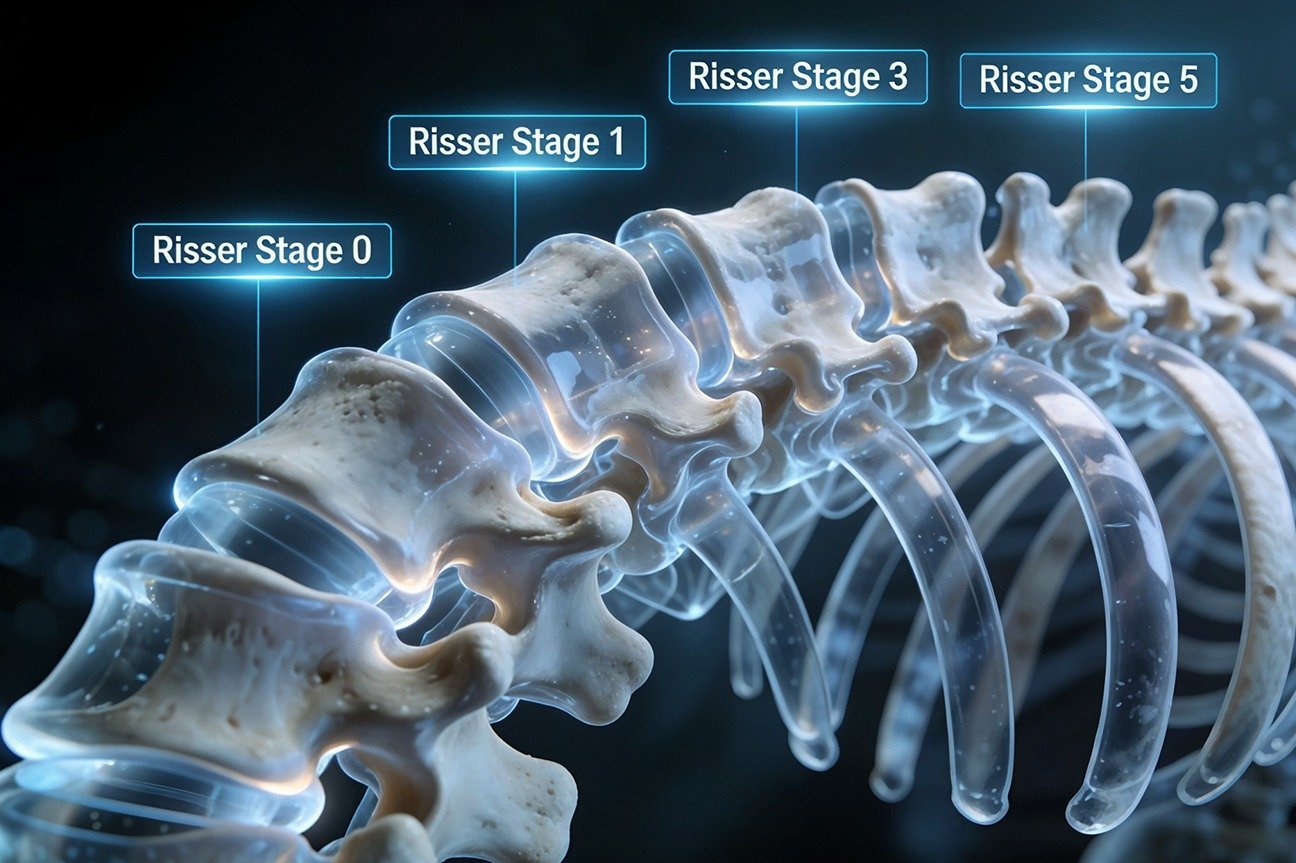
Scoliosis does not progress at a fixed rate. Its trajectory is tightly linked to skeletal maturity, specifically the growth velocity that peaks during the pubertal growth spurt. For most adolescent patients, this window spans approximately two to three years and corresponds closely with the early Risser stages. During this period, the spine is maximally responsive to corrective force and maximally vulnerable to progressive deformity if that force is absent.
A patient presenting with a 20-degree Cobb angle at age twelve is not the same clinical proposition as the same patient at fifteen with a 38-degree curve. The structural changes that accumulate during unmanaged progression, such as vertebral wedging, rib rotation, and rotational deformity, do not reverse on their own. They become the baseline from which all future corrections must work.
When clinicians observe without intervening, they are not holding the situation stable. They are allowing a three-dimensional deformity to entrench itself during the precise period when the body is most capable of being guided differently.
The Surgical Threshold Is Not a Natural Outcome
One of the most damaging narratives embedded in the “wait and watch” approach is the implicit suggestion that surgical intervention is simply what happens when scoliosis reaches a certain severity, a natural endpoint rather than a clinical failure.
The surgical threshold for adolescent idiopathic scoliosis is conventionally set at curves exceeding 45 to 50 degrees Cobb. At this point, spinal fusion is typically recommended. Fusion surgery permanently eliminates mobility across the fused segments, carries a recovery period measured in months, and does not eliminate the underlying structural deformity. It arrests it.
For the majority of patients who reach this threshold, the journey there was not inevitable. It was the cumulative result of a growth window spent monitoring rather than correcting. The surgery that follows is, in many cases, the outcome of a missed opportunity, not the unavoidable conclusion of a natural disease process.
A New Clinical Standard
Responsible, evidence-aligned management of adolescent scoliosis begins with accurate risk stratification at diagnosis. Not all scoliosis curves are equivalent. A 15-degree curve in a skeletally mature patient behaves very differently from the same measurement in a young patient approaching peak height velocity. Effective management requires assessing:
• Skeletal maturity and Risser stage
• Growth velocity and proximity to peak height velocity
• Curve magnitude and pattern
• Degree of vertebral rotation
• Sagittal profile
For patients with progressive curves in skeletally immature stages, active intervention should begin promptly. This means a structured, curve-specific exercise programme, not generic core strengthening designed around the patient’s exact curve geometry. For curves that meet clinical thresholds or demonstrate progression despite exercise, hyper-corrective bracing should be introduced not as a last resort before surgery, but as a primary corrective tool deployed during the window when it is most likely to succeed.
Monitoring has a role. But monitoring should accompany active intervention, not replace it.
The Conversation That Needs to Happen
Conservative correction works. It works better the earlier it begins. And the structural window during which it works most effectively is finite; it closes with skeletal maturity.
Every year of passive observation during that window is a year of corrective potential that cannot be recovered.
This is not a fringe position. It is the direction the evidence has been pointing for more than a decade. The SOSORT guidelines reflect it. The published research reflects it. What has not yet caught up is routine clinical practice, particularly across Singapore, Malaysia, and Indonesia, where scoliosis awareness remains low, specialist access is limited, and “wait and watch” continues to be the first and only guidance families receive.
The standard of care for adolescent idiopathic scoliosis must evolve. The tools exist. The evidence exists. What is needed now is the clinical will to apply them.
At ScolioLife®, we combine the hyper-corrective ScolioAlign® brace with the ScolioLife® Method of exercises, customised routines tailored to your exact curve. Early action changes outcomes. We are ready when you are.