
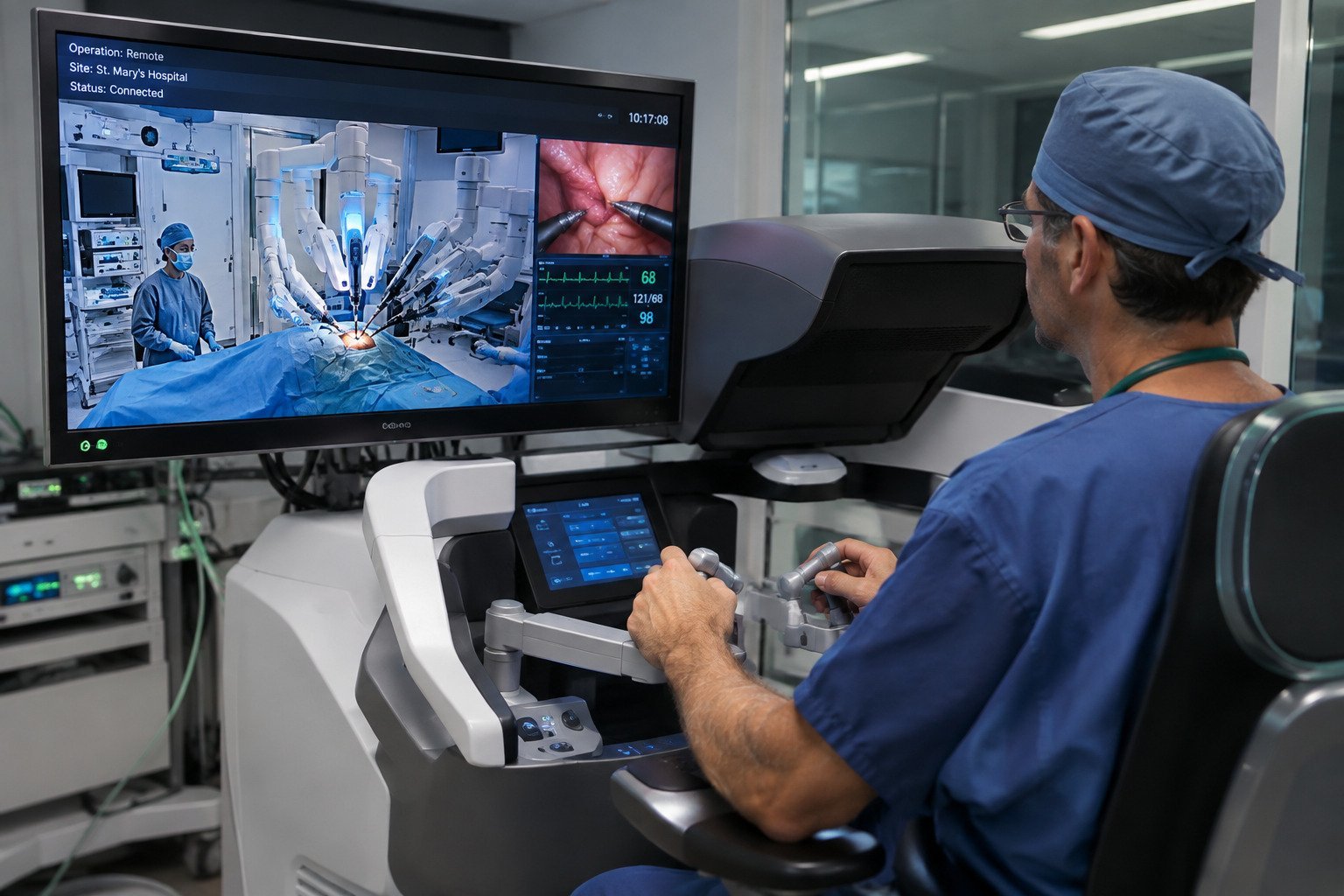
In the evolution of modern healthcare, the operating room has always been a center of precision, discipline, and human expertise. Today, it is undergoing a profound transformation. The convergence of robotics, augmented reality, and remote connectivity is redefining how surgeries are performed, who performs them, and where they can take place.
What was once dependent solely on the physical presence and manual skill of surgeons is now being augmented by intelligent systems that enhance accuracy, expand access, and introduce entirely new surgical possibilities.
The operating room of the future is no longer confined by walls. It is becoming a connected, data-driven environment where technology amplifies human capability.
The Rise Of Robotic-Assisted Surgery
Robotic systems have become one of the most visible advancements in surgical practice. These platforms enable surgeons to perform complex procedures with enhanced precision, control, and stability.
Robotic-assisted surgery allows for smaller incisions, reduced blood loss, and improved recovery times compared to traditional open procedures. Clinical research published in JAMA Surgery indicates that robotic systems can improve surgical accuracy and consistency, particularly in minimally invasive procedures.
These systems do not replace surgeons. Instead, they extend their capabilities by translating hand movements into highly refined micro-movements, reducing natural human limitations such as tremor.
As adoption increases, robotics is becoming an integral component of surgical workflows across specialties, including urology, cardiology, and neurosurgery.
Augmented Reality: Enhancing Surgical Vision
While robotics enhances physical precision, augmented reality is transforming how surgeons visualize the human body.
Augmented reality overlays digital information onto the surgical field, allowing surgeons to see anatomical structures, tumor boundaries, and critical pathways in real time.
Research published in the Annals of Surgery shows that augmented reality enables accurate visualization of anatomical structures and provides three-dimensional guidance during surgery, improving spatial understanding and supporting more precise intraoperative navigation.
By integrating imaging data such as CT and MRI scans directly into the surgical field, AR reduces uncertainty and enhances decision-making.
This shift from indirect visualization to immersive guidance represents a major leap in surgical intelligence.
Remote Surgery And The Expansion Of Access
Perhaps the most transformative development is the emergence of remote surgery.
Advances in high-speed connectivity and robotic systems are making it possible for surgeons to operate on patients from geographically distant locations.
Remote surgery can bring specialized expertise to underserved regions, reduce the need for patient travel, and enable rapid response in emergency situations where local surgical expertise may be limited.
In a global healthcare system marked by unequal access, this technology has the potential to bridge critical gaps.
The Role Of Artificial Intelligence In The Operating Room
Artificial intelligence is emerging as the intelligence layer that connects and enhances these technologies.
AI systems can analyze surgical data, predict complications, and assist in decision-making during procedures.
Over time, AI could enable more adaptive surgical environments where systems learn from each procedure and continuously improve performance.
The integration of AI transforms the operating room from a static environment into a dynamic, learning system.
Challenges: Safety, Ethics, And Reliability
Despite these advancements, the future operating room is not without challenges.
Robotic systems and remote procedures introduce new risks related to system failure, latency, and cybersecurity. Ensuring reliability and patient safety remains critical.
Ethical considerations are equally important. Questions around accountability, data privacy, and informed consent become more complex when technology plays a central role in surgical decision-making.
Global health discussions emphasize the need for strong regulatory frameworks to ensure that innovation does not compromise patient safety or ethical standards.
The balance between technological advancement and human oversight will define the success of these systems.
Redefining The Role Of The Surgeon
As technology becomes more integrated into surgical practice, the role of the surgeon is evolving.
Surgeons are no longer only operators. They are becoming decision-makers, system managers, and collaborators with intelligent technologies.
Training programs are already adapting to this shift, incorporating robotics, simulation, and digital tools into surgical education.
The future surgeon will require not only clinical expertise but also technological fluency.
Conclusion: The Connected Operating Room
The operating room is being transformed from a physical space into a connected ecosystem powered by robotics, augmented reality, and remote capabilities.
These technologies are enhancing precision, expanding access, and redefining what is possible in surgery.
At the same time, they demand careful consideration of safety, ethics, and governance.
The future of surgery will not be defined solely by machines or algorithms. It will be shaped by how effectively technology and human expertise are integrated.
In this new era, the operating room is no longer just a place where procedures happen.
It is a platform where the future of medicine is being built.