
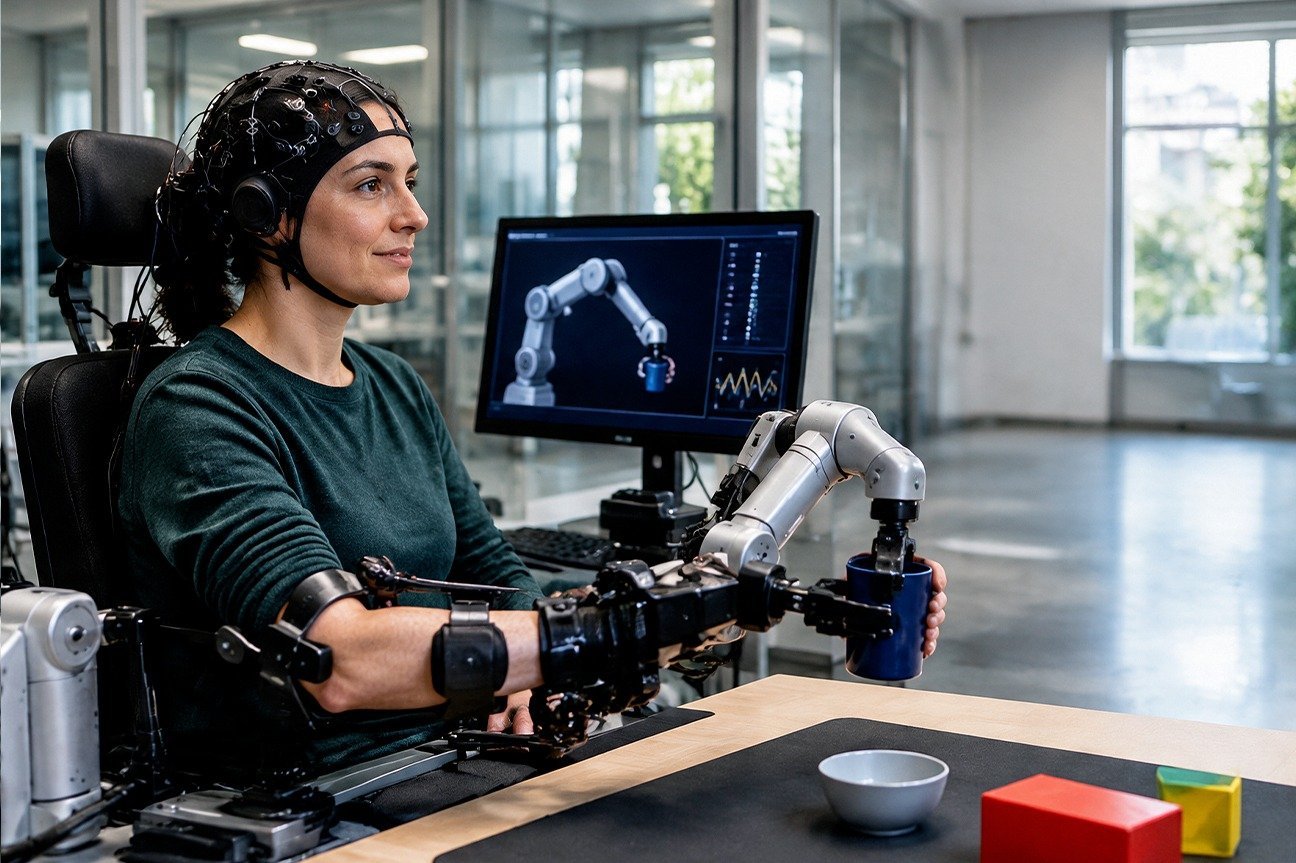
In the architecture of human progress, technology has consistently extended the boundaries of what individuals can achieve. From tools that amplified physical strength to systems that enhanced cognitive processing, each advancement has redefined capability. Today, brain-computer interfaces are emerging as one of the most transformative innovations, directly connecting human neural activity with digital systems and reshaping the relationship between mind and machine.
Brain-computer interfaces, or BCIs, establish a direct communication pathway between the brain and external devices. This enables neural signals to be translated into actionable outputs without physical movement, fundamentally changing how humans interact with technology. What was once experimental is now advancing toward real-world application, bringing both opportunity and complexity.
From Restoration To Expansion Of Capability
The earliest applications of brain-computer interfaces were rooted in medical necessity. These systems were designed to restore lost functions in individuals with severe neurological conditions, enabling communication and movement where traditional pathways had failed.
Clinical research demonstrates that BCIs can translate neural activity into commands, allowing individuals with paralysis to control digital interfaces and assistive devices through thought alone, improving independence and quality of life.
This capability represents a major advancement in neurorehabilitation. However, the trajectory of BCI development is no longer limited to therapeutic applications.
Research increasingly highlights that the same technologies used for restoration are now being explored for enhancement, including applications in cognitive performance, human-machine interaction, and immersive digital environments.
This shift marks a fundamental transition from compensating for limitations to expanding human potential.
The Intelligence Layer Behind BCIs
The effectiveness of brain-computer interfaces depends on the ability to interpret complex neural signals. Advances in artificial intelligence and computational neuroscience are making this possible.
AI systems can process large volumes of neural data, identify patterns, and translate them into meaningful outputs in real time. This capability is enabling more precise control of external systems and improving the accuracy of brain signal interpretation.
Global technology discussions emphasize that the convergence of artificial intelligence, neuroscience, and advanced materials is accelerating the development of BCIs capable of interacting with the brain with increasing precision and adaptability.
As a result, BCIs are evolving from simple assistive tools into sophisticated systems that can integrate seamlessly with human cognition.
The Economic Acceleration Of Neurotechnology
The rapid development of brain-computer interfaces is also being driven by significant economic investment and growing market demand.
Industry analyses indicate that the global BCI market is expanding rapidly, with projections suggesting growth from approximately $1.74 billion in 2022 to over $6.2 billion by 2030.
This growth reflects increasing interest across healthcare, technology, defense, and consumer sectors. As innovation scales, BCIs are moving from research environments into commercial and clinical ecosystems.
The transition from experimental technology to mainstream adoption is already underway.
Ethical Complexity In Direct Brain Interaction
Unlike traditional digital systems, brain-computer interfaces interact directly with neural activity, making their ethical implications significantly more complex.
A comprehensive analysis in BMC Medical Ethics highlights that BCIs introduce critical concerns related to autonomy, privacy, responsibility, and justice, particularly because they engage directly with human cognition and decision making.
This raises fundamental questions about control and consent. When technology can interpret or influence brain signals, ensuring that individuals retain full agency over their thoughts becomes essential.
The challenge is not only technological but also philosophical, requiring a redefinition of boundaries between human intention and machine interpretation.
Risk, Security, And Cognitive Privacy
As brain-computer interfaces become more advanced, concerns about data security and misuse are becoming increasingly relevant.
Technology assessments highlight that BCIs introduce new categories of risk, including the potential for unauthorized access to neural data and vulnerabilities within connected systems.
Because neural data reflects cognitive processes, the stakes are significantly higher than traditional data breaches.
In addition to technical risks, there are broader societal implications. Unequal access to advanced neurotechnology could create disparities in cognitive and functional capabilities, potentially reshaping economic and social structures.
These concerns emphasize the need for robust safeguards and ethical frameworks.
Redefining Human Identity And Capability
The most profound impact of brain-computer interfaces lies in their ability to challenge traditional definitions of human capability.
The brain is not simply an organ. It is the foundation of thought, identity, and consciousness. Technologies that interact directly with neural processes, therefore, influence the very core of human experience.
As BCIs enable new forms of interaction between mind and machine, they raise critical questions about individuality, authenticity, and the limits of enhancement.
The distinction between human capability and technological augmentation is becoming increasingly fluid.
Conclusion: The Future Of Human Capability
Brain-computer interfaces represent a new frontier in the evolution of human capability.
They offer the potential to restore lost functions, enhance cognitive performance, and transform how humans interact with technology. At the same time, they introduce ethical, social, and philosophical challenges that must be addressed with care.
The future of BCIs will not be defined solely by technological innovation. It will be shaped by the frameworks that govern their development and use.
As the boundary between brain and machine continues to evolve, one reality becomes clear.
Human capability is no longer fixed. It is being redefined.