
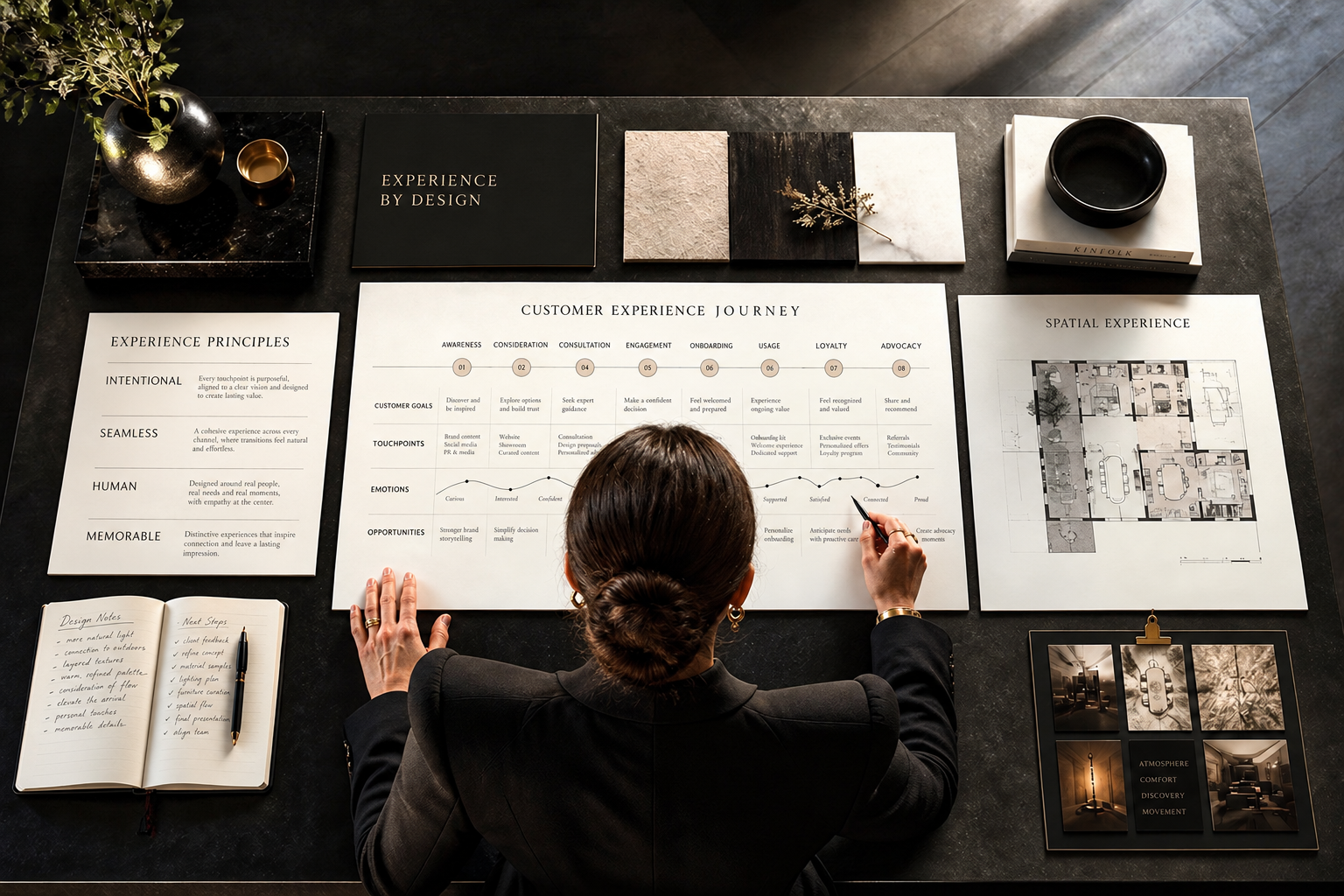
Aesthetic intelligence is one of the most underestimated drivers of value, differentiation, and emotional connection.
Many businesses still treat design as a final layer rather than a foundational strategy. It is often reduced to visual elements, a colour palette, a logo, or a carefully selected font added after the important decisions have already been made. But meaningful design goes far beyond appearance. It should be embedded into the core thinking of a business from the very beginning, shaping how products, spaces, and experiences are conceived long before they are created.
The way something looks, feels, and functions is not separate from its value; it is its value, at least in the mind of the person experiencing it. Perception is not a superficial response. It is the mechanism through which humans assign meaning, quality, and worth to everything they encounter. Businesses that understand this do not simply create products or spaces. They create experiences that people are willing to invest in, financially, emotionally, and repeatedly. The companies most admired for their design are not celebrated because they made beautiful things. They are celebrated because they understand that design is a system of decisions, and that every decision either builds or erodes the perception of value. That understanding is not an aesthetic sensibility. It is a competitive strategy.
Why Design Shapes Perception Before Words Ever Do
The human brain makes judgments faster than conscious thought can intervene. Lindgaard et al. (2006) state that visual appeal can be assessed within 50 milliseconds, meaning first impressions are formed almost instantly, before conscious evaluation begins. By the time a potential client has consciously registered what they are looking at, they have already decided how they feel about it.
This is a fundamental feature of human cognition rooted in fast, intuitive, automatic thinking that governs most everyday judgments. Design is doing its most consequential work before any conversation begins. Before a sales pitch is delivered, before a specification sheet is read, before a price is disclosed, the visual and spatial experience has already shaped the frame through which everything else will be interpreted. A beautifully designed product feels more capable. A thoughtfully designed space feels more valuable. A coherently designed brand feels more trustworthy.
Research has found that up to 90% of snap judgments made about products can be based on colour and visual composition alone, influencing perceptions of quality and premium positioning before any functional attribute is considered. For businesses competing in markets where differentiation is difficult, and attention is scarce, this is not an abstract insight. The first impression is not a preamble to the experience. It is the experience, or at least the lens through which every subsequent element will be judged.
Emotional Value As A Competitive Advantage
There is a persistent assumption in business that value is primarily rational, that clients pay for performance, specification, and utility. This assumption is incomplete. Emotional response is frequently the primary driver of purchasing decisions, particularly in high-involvement categories where the stakes are significant.
The McKinsey Design Index, tracking 300 publicly listed companies over five years, found that design leaders outperformed industry counterparts by 32% in revenue growth and 56% in total shareholder returns. This premium reflects a fundamental truth: when two products offer comparable functional performance, the one that creates a stronger emotional response commands a higher price, generates stronger loyalty, and sustains its market position more durably. Design is the primary mechanism through which that emotional response is engineered.
Consider the luxury goods sector, where this principle is most visible. A premium bag and a high-street alternative may serve the same function, but the price difference is driven by design choices such as proportion, material, detail, packaging, and experience. Together, these elements signal quality and rarity, creating emotional value beyond function. The same applies across industries like real estate, hospitality, financial services, and technology, where strong design consistently leads to better pricing power, lower churn, and higher client lifetime value.
Consistency Builds Brand Authority
A single well-designed product is impressive. A coherent design language sustained across every touchpoint, physical, digital, and experiential, is transformative. Consistency is what converts individual design decisions into brand authority, and brand authority is what creates recognition and trust that no advertising budget can simply purchase.
Consistency works because the human brain is a pattern-recognition engine. Repeated exposure to coherent visual signals builds familiarity, and familiarity breeds trust. The mere exposure effect, documented by social psychologist Robert Zajonc, demonstrates that people develop preferences for things simply through repeated encounters. For brands, every inconsistency is a missed opportunity to reinforce recognition, and every serious inconsistency actively erodes the trust that has been painstakingly built.
Apple has consistently emphasized the close integration of hardware and software, designed to make technology feel intuitive, seamless, and engaging to use.
The Hidden Cost of Design Failure
Design failure rarely announces itself dramatically. It operates through accumulation, a series of decisions that individually seem minor but collectively communicate something damaging: that quality, coherence, and the client's experience were not priorities.
The Design Management Institute found that over a ten-year period, design-led companies outperformed the S&P 500 by 219%, implying that companies neglecting design are systematically destroying value relative to their potential. In real estate, the consequences are immediate: a poorly conceived spatial layout, an incoherent material palette, or a mismatch between design language and target market suppresses both demand and achievable price, not because the underlying asset lacks merit, but because perception has been mismanaged.
Conclusion
In business, design is not an aesthetic choice, but a strategic one. The businesses that win are those that recognise that how something feels is as important as what it is.
Every decision about how something looks, feels, and functions is a decision about what it communicates, about quality, about values, and about the seriousness with which a business regards the people it serves. In a marketplace increasingly defined by parity of function and abundance of choice, design is frequently the only meaningful differentiator remaining. It is the difference between a product that is chosen and one that is merely considered, and between a brand that commands a premium and one that competes on price alone.
The question every business leader should ask is not "Does our design look good?" It is "Does our design do its job?", which is to make people feel, before they think, that what you offer is worth more than what they must give up to have it